
Futures by Design PK-12
Creating explicit connections between today’s learning and tomorrow’s future is part of the St. Vrain Advantage.
The World Economic Forum’s Future of Jobs Report 2025 projects that 22% of today’s formal jobs will be structurally transformed by 2030, with 170 million jobs created and 92 million displaced. It also estimates that 39% of workers’ existing skill sets will be transformed or become outdated by 2030. To prepare students for a dynamic and rapidly accelerating era of information and innovation, we are committed to equipping educators and students with the tools, skills, and resources needed to provide current and future generations a strong competitive advantage so that all students can achieve success in a globalized world:
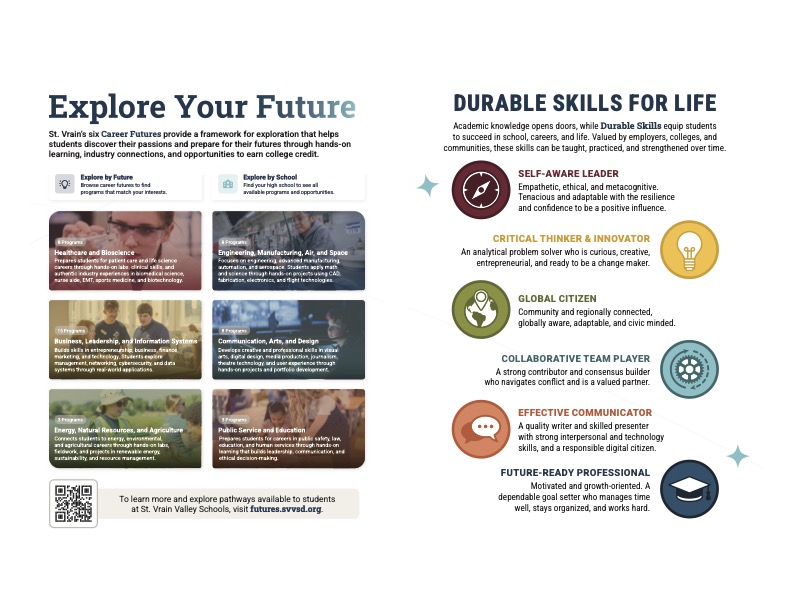
- Embed Future-Ready Skills: Integrate Al literacy, personal financial literacy, and durable skills directly into core content. The Durable Skills equip students with the tools they need to succeed in school, careers, and life, creating a systemic approach to lifelong learning. Valued by employers, colleges, and communities, these skills can be taught, practiced, and strengthened over time.
- Self-Aware Leader
- Critical Thinker & Innovator
- Global Citizen
- Collaborative Team Player
- Effective Communicator
- Future-Ready Professional
- Increase Student Agency: Provide design challenge experiences that foster a bias toward action and perseverance through feedback.
- Strengthen Career Connections: Build a structured PK-8 continuum aligned with high school pathways and local community needs.
St. Vrain has identified six Career Futures that provide a framework for exploration that helps students discover their passions and prepare for their futures through hands-on learning, industry connections, and opportunities to earn college credit:
- Healthcare and Bioscience
- Business, Leadership, and Information Systems
- Energy, Natural Resources, and Agriculture
- Engineering, Manufacturing, Air, and Space
- Communication, Arts, and Design
- Public Service and Education
Explore these Career Futures, innovative focus programs, and career-connected coursework available to all high school students at futures.svvsd.org.
How Can Families Support Durable Skills?
Students learn more than academics at school. They develop the skills to solve problems, collaborate, communicate, navigate challenges, and contribute to their communities.
St. Vrain’s six Durable Skills provide a shared language for these essential capabilities. Valued by employers, colleges, and communities, these skills can be taught, practiced, and strengthened over time.
Students build these skills through everyday experiences, such as solving problems together, working through disagreements, setting goals, and learning from mistakes.
Families can support this growth through simple conversations. Try asking your child:
- Which Durable Skill did you use today?
- What was challenging, and how did you handle it?
- How did you help someone or work with others?
- What skill would you like to keep practicing?
When schools and families work together to reinforce Durable Skills, students build the confidence and capabilities to thrive in school, their communities, and the future.
The following questions can be discussed at home as an extension of each Durable Skill beyond the classroom and school.
Self-Aware Leader
- What made you feel happy or proud today?
- What was hard today, and what helped you keep trying?
- Everyday opportunities to practice with your elementary student:
- Decide how to respond when frustrated, disappointed, or upset with a sibling.
- Share something they are proud of or something they have learned to do well.
- Talk about something that did not go as planned and what they might try differently next time.
- Everyday opportunities to practice with your middle school student:
- Think about a recent decision and how it affected themselves and others.
- Check in with a parent or trusted adult about a personal strength or an area they want to improve.
- Acknowledge when they make a mistake, apologize when appropriate, and work to make things right.
Critical Thinker & Innovator
- What is something you wonder about?
- What are different ways we could solve a problem?
- Everyday opportunities to practice with your elementary student:
- Figure out how to organize toys, make room for something new, or solve a small problem around the house.
- Help prepare a meal and think about what could be changed if a recipe does not turn out as expected.
- Create a new game, build something with household materials, or find a way to make an everyday task easier.
- Everyday opportunities to practice with your middle school student:
- Identify a household challenge and propose a solution, such as improving a shared space or reducing food waste.
- Choose a meal, consider dietary needs and preferences, plan ingredients, and adjust based on the available budget.
- Try different strategies to fix a problem before asking someone else to solve it.
Global Citizen
- How did you show respect today?
- How could we help someone this week?
- Everyday opportunities to practice with your elementary student:
- Help clean up a park, playground, neighborhood, or other community space.
- Sort recycling, turn off unused lights, conserve water, or help care for a garden.
- Welcome someone new, include a sibling or friend in an activity, or make sure others feel they belong.
- Everyday opportunities to practice with your middle school student:
- Learn about a local need or concern and identify a way to help.
- Participate in a community service project, volunteer opportunity, or neighborhood initiative.
- Learn about an issue from multiple viewpoints and discuss why people may see it differently.
Collaborative Team Player
- What makes someone a good teammate?
- How can we give everyone a chance to share?
- Everyday opportunities to practice with your elementary student:
- Practice listening, taking turns explaining their ideas, and finding a solution with a sibling.
- Help a sibling or family member clean a room, prepare dinner, or complete a project.
- Share ideas and listen to others when deciding on a family activity or meal.
- Everyday opportunities to practice with your middle school student:
- Work with siblings or family members to plan and complete a household project.
- Help a younger sibling with homework, practice a skill, or learn something new without simply doing it for them.
- Help plan a trip, celebration, or weekend activity by gathering ideas and finding common ground.
Effective Communicator
- How can we show that we are listening?
- What can we do when we disagree?
- Everyday opportunities to practice with your elementary student:
- Use kind words, say please and thank you, and disagree respectfully.
- Use words to explain when they need help, feel frustrated, or have a different idea.
- Practice listening to a family member without interrupting and asking questions to learn more.
- Everyday opportunities to practice with your middle school student:
- Share opinions and ideas about current events, books, school experiences, or family decisions while listening to other perspectives.
- Communicate their needs, ask questions, and respectfully seek help when necessary.
- Think about tone, audience, privacy, and the impact of digital messages before posting or sending them.
Future-Ready Professional
- What is one goal you have this week?
- What small step could help you reach it?
- Everyday opportunities to practice with your elementary student:
- Choose something they want to learn or improve, such as reading more books, learning to ride a bike, or practicing a sport.
- Take responsibility for getting ready in the morning, packing a backpack, or preparing for bedtime.
- Break a bigger task, such as cleaning a room or completing a project, into smaller steps.
- Everyday opportunities to practice with your middle school student:
- Keep track of assignments, activities, responsibilities, and deadlines using a calendar or planner.
- Manage homework, chores, personal belongings, and commitments with increasing independence.
- Plan how to save and spend money toward something they want or need.