You’re Invited: St. Vrain Valley Schools to hold virtual performing arts college information night on September 22

On Tuesday, September 22 from 6:00-8:00 P.M., all students who are interested in pursuing higher education in the performing arts are invited to attend St. Vrain’s performing arts college information night. Interested families must register ahead of the event to receive their invitation to the Webex event at http://stvra.in/performingarts.

This will be the second year St. Vrain has hosted a performing arts college information night. Last year, Erie High School hosted the event where over 150 people from across the district attended.

“After last year’s successful turnout, we are excited to be offering the event again this year in a virtual format,” said Scott Wright, Erie High School Theater Teacher. “The goal is to continue bringing together leading performing arts college programs from across the state to help assist students in their future education endeavors, as they continue to aspire and reach towards their dreams in the performing arts.”

The event will feature faculty and staff from the University of Denver, DIME Denver, the University of Colorado, Colorado State University, and the University of Northern Colorado. Speakers will share information with students and parents considering pursuing a degree in dance, music, and theater. Topics will include programs and degree opportunities, the performing arts college application process, questions to ask potential colleges, scholarship opportunities, and the audition process during the time of COVID-19.

The event’s main speaker and facilitator is Director of Admission and Recruitment at the University of Colorado Boulder, Veronica McClellan. “Ultimately, this event serves as a really easy-to-digest way to learn and understand the logistics of applying and auditioning to Colorado programs, and also a way to better understand what questions to be asking any institution across the country,” said McClellan. “Colorado is home to a rich pool of bright, talented, up-and-coming artists and it’s so important to us to provide good information about the paths forward so they can feel empowered to pursue their dreams.”

Project kits provide hands-on learning from home for Longmont’s Career Development Center students

Packaged in plastic boxes and bags, hundreds of project kits created for St. Vrain Valley School District students enrolled in the Career Development Center awaited pick up Friday in the parking lot at 1200 Sunset St.

Under tents set up outside the building, masked students relished a moment to have face-to-face contact with their instructors, before heading home with their assignments in hand.

The take-home project kits will be a new normal for students enrolled in the district’s technical education programs. With the district opting for a remote start to the school year, in wake of the coronavirus pandemic, the idea was to give students some of the same hands-on experiences they would be getting in the classroom, said Charles “Buck” Webber, the assistant principal for the Career Development Center.

The little fish that could: Despite COVID-caused changes to program, St. Vrain students, partners reintroduce redbelly dace into wild

While “innovation” in the Innovation Center’s name conjures up images of robotics and aeronautics and other high-tech fields, it doesn’t exclude conservation. “Although it’s not a biology center or an ecology center, they’re innovating how to raise these fish,” Boulder County Parks and Open Space wildlife biologist Mac Kobza said.

Tuesday was a day for the “nerds.”

Technically, it was a day for the NRDs — northern redbelly dace — and the St. Vrain Valley School District students, educators and others who were all part of a project to reintroduce the endangered fish into the St. Vrain River ecosystem.

P-TEACH Grads Return to Classroom as Apprentice Teachers

Just three months after finishing high school, some recent graduates are back in St. Vrain  classrooms. Eight members of the inaugural class of the Pathways to Teaching (P-TEACH) program are working as apprentice teachers at Mountain View Elementary and Timberline PK-8. Apprentices are paraprofessional educators, who, under the direction of a classroom teacher, work to support student learning through a wide range of planning, instruction, and clerical duties.

For 20 hours a week, P-TEACH apprentices gain real work experience as paraprofessionals, while receiving added mentorship from a classroom teacher and weekly 1:1 coaching from their P-TEACH NxtGEN @ St. Vrain Coordinator and Instructor, Nicole Rudman. The rest of the week, they are enrolled as students at the University of Colorado Denver and Front Range Community College, working to earn credits toward their bachelor’s degrees in early childhood education, elementary education, or elementary special education.

Deejha Blash-Lopez, a 2020 Longmont High School graduate, works at Mountain View Elementary School with kindergarten teacher Lauren Vargas.

“Through this experience I get to apply what I’m learning in class and see it actually happen,” says Blash-Lopez. “I am able to see all the behind the scenes work of the classroom, which helps me get a deeper understanding of all of the work that it takes to become a teacher.”

The P-TEACH program was developed in 2018 with grant funding from an Early Childhood Workforce Innovation Grant through the Transforming the Early Childhood Workforce in Colorado Initiative, which is funded by Buell Foundation and Gary Community Investments and led by Early Milestones Colorado, as well as a Colorado Department of Higher Education Plan Into Action grant. Through the customized pathway program, aspiring young educators can pursue teaching careers in high school by getting a head start on their post-secondary education through concurrent enrollment at CU Denver while also gaining hands-on work experience.

St. Vrain received a second Transforming the Early Childhood Workforce in Colorado investment this spring, adding $190,000 in support of the expansion of the P-TEACH program to include a four-year bachelor’s degree pathway for both recent graduates and adult paraprofessionals seeking to advance their education careers. The grant provides funding for P-TEACH NxtGEN students for identified college-level coursework at Front Range and CU Denver, all of which will transfer to CU Denver to be applied toward their degree requirements.

“Expanding our program gives us the opportunity to support our diverse community of P-TEACH graduates as they study to become future educators, many of whom are the first in their families to attend college,” Rudman, the P-TEACH NxtGEN @ St. Vrain Coordinator and Instructor, says. “Through their apprenticeships, they can apply the theories that they are learning in college to the real world of the classroom, all while having the support of their fellow cohort members, their mentor teacher, and NxtGEN coach.”

For Blash-Lopez and her peer cohort, the ultimate goal is to become a lead classroom teacher. As they complete their studies at CU Denver, the P-TEACH apprentices will continue to work as paraprofessionals for three years, followed by a year of student teaching. They will graduate college with a competitive advantage, ready to join the workforce and inspire the next generation in St. Vrain, and beyond.

“I want to try and be a positive teacher and help make kids want to learn,” Blash-Lopez says. “I love seeing when children start to progress and you can see how excited they get when they learn something new. I want to try and ignite that spark for learning.”

Project Launch Algebra Summer Program

Summer programming is a great way for students at all levels and abilities to gain new skills, master challenging content, and get a head start on the year ahead. This summer, with the support of 22 teachers, 174 incoming ninth grade students had the opportunity to be part of the district’s inaugural Algebra 1 Focus Program. The four-week summer program took place in June and was offered at each feeder high school throughout the district.

Project Launch Algebra was designed as a bridge from eighth grade math to Algebra 1, focused on math standards that feed into the first semester of high school. During spring of 2020, teachers were asked to choose students that if given the right classroom support, cooperative learning, smaller class sizes, and engaging content, would succeed in math.

The design of Project Launch Algebra was to expose students to many different forms of mathematical thinking, explicit instruction, meaningful applications of concepts, and reflection opportunities.

“For students, our goal was for them to leave with a positive perception of math and equip them with a mindset that they can succeed in learning and understanding math with the right conditions in place,” shared Greg George, K-12 Mathematics Coordinator. “For teachers, we wanted to provide instruction materials and daily routines that modeled best practices in the teaching and learning of mathematics, including the use of formative assessment data to dive instruction.”

Classes had six to nine students, allowing better collaboration between students in a smaller group setting. 

“It was fun to see students persevere as they tackled some challenging problems, as the 9:1 student to teacher ratio really allowed for teachers to build that safe community necessary for students to succeed,” shared Kelly Addington, Learning Coach.

The program ran for two weeks with in-person learning, three hours a day, and one week via Webex for one hour a day.

“I was blown away by the eagerness of students who participated in the program,” shared Instructional Coordinator Lindsay La Porte. “The conversations I heard in classrooms demonstrated deep, mathematical thinking.”

The curriculum was designed to provide a balance between short and intensive direct instruction, student exploration, and rigor. It gave incoming ninth grade students the opportunity to explore complex mathematical problems and increased confidence in students’ ability to tackle problems, providing them the help they needed to successfully be prepared for Algebra 1.

“I have learned and grown greatly in the last two weeks, and feel more comfortable with the whole idea of algebra – I’ve learned many new things about myself, and about the whole idea of making and solving equations, and I plan to learn more,” shared a student participating at Silver Creek High School.

Even though the focus of this program was centered around boosting a students’ confidence in math, this was also a very important part of their transition from middle school to high school. Face-to-face experience between students and teachers, and connections students made, were invaluable in providing a strong foundation for when they enter high school.

“Even in this time, education, teaching, and learning can continue and be powerful,” said La Porte.

Taking the New School Year by #StVrainStorm

As we begin a new school year in an unprecedented time, St. Vrain Valley teachers and staff are rising to the challenge of teaching in a virtual environment. Together, we will move forward and come through this as a stronger system. 

 See highlights below from our teachers, staff, and community of our first few days and months of preparation for the 2020-2021 school year.

#StVrainStorm


Powered by Curator.io

Thriving Virtually – St. Vrain teachers rise to the challenge of online learning

“What is the name of your favorite childhood teacher?” For most, the answer does more than fulfill the requirements of an online security question, it conjures up memories of meaningful connection and lasting impact. Chances are, the teacher that holds that prestigious title does so for many reasons — they fostered meaningful relationships, made content relevant and fun, and exuded a contagious passion for learning. They also might have offered a steady presence during a challenging time in life.

On March 13, when the coronavirus pandemic forced St. Vrain’s buildings to close, learning moved online and, under unprecedented circumstances, teachers were challenged to access those traits that make them great. As they packed up their classrooms and reassembled them on their kitchen tables, teachers rose to the challenge, working tirelessly to maintain a prominent role in their students’ lives. Though classroom spaces were fundamentally changed, what makes a teacher great stayed the same.

Relationships

Theodore Roosevelt once said that “people don’t care how much you know until they know how much you care.” Lauren Vargas at Mountain View Elementary knows this is especially true for her kindergarten students. In her five years in St. Vrain, for Vargas, it has always been about “relationships—number one; all day every day.”

Most students enter kindergarten unable to read, presenting a pedagogical challenge in and of itself. Maintaining a virtual relationship with a five year old who can’t read is daunting, maintaining thirty of them can seem impossible. But Vargas did not allow the magnitude of the task to dampen her desire to connect with every one of her students. As students submitted their assignments online, she recorded voice comments to give individual feedback. “I commented on every single thing they turned in so they knew I value the work they are doing, so they know it’s important for me,” she said. 

Though kindergarten students may be limited in their ability to write in complete sentences or paragraphs, Vargas believes they are not limited in their thinking. She encouraged students to talk to her, to show her what they are thinking through voice memos and videos. She also created interactive events like bedtime video read-aloud sessions and live virtual field trips to the San Diego Zoo, the Georgia Aquarium, and the Butterfly Pavilion.

Vargas also realized the importance of connecting with families. She regularly made phone calls to check in on her students, asking open-ended questions like, “What is working? What can I change? And, how can I better connect with your child?” 

One of the primary goals of early childhood education is to help students fall in love with learning, and peak moments are a critical element of this. Vargas refused to let the pandemic strip away every peak moment, and instead, nurtured relationships with students and families to help ensure both personal and academic success for years to come.

Relevant and Fun Content

Under normal circumstances, Jason Turner’s physical classroom at Sunset Middle School awakens your creativity. Upbeat music buzzes softly in the background, soft lamps illuminate student artwork hanging on every open inch of wall space, and the smell of oil pastels and clay transport you from the adjacent sterile locker bay to an inspiring art studio.

It is natural to assume that for an elective course tied to a physical space and reliant on materials like kilns and clay, no virtual option for art class could suffice. But for Turner, art is much more than a line on a student’s schedule or a room they sit in during third period. “Art is all around, art is literally everywhere, and my goal is to help students see that,” he says.

Sunset Assistant Principal Mary Ellen Graziani was especially impressed by Turner’s ability to build powerful connections with his students and then co-develop projects where they could use their home environment to create amazing art. Rather than assigning traditional art projects revolving around certain physical materials, Turner encouraged his students to find materials around their homes and use them to create art. It is difficult to be apathetic toward art when it can be discovered anywhere around you. 

Turner developed a Quarantine Digital Art Show 2020 to showcase his students’ work, and the site has been viewed thousands of times by teachers, parents, community members, and students. As part of the exhibition, one student organized some of his favorite objects to spell out his name, another arranged objects in her room to create a color scale, and others explored the outdoors for “found object mandalas.” Some students layered objects from their kitchen over top of pencil drawings, while others dressed up to stage recreations of famous paintings. 

An important component of student motivation is understanding the audience for which they create. Turner made sure that his students knew that what they created didn’t just fill their teacher’s crowded inbox, it was displayed publicly to inspire others. “When students are home, it’s more important than ever that what they are doing goes somewhere. I want to push their work into a public-facing product.”

Passion for Learning

Nothing evokes more pride in a teacher than when a student walks out of their classroom with more love for a subject than they had when they walked in. For eight years as an AP U.S. HIstory teacher at Skyline High School, Caitlin McGinn has worked hard to foster in her students a deep, enduring love for the subject of history.

“She is just a phenomenal teacher,” raves Skyline Principal Heidi Ringer, “and you’ll hear that from everyone — parents, students, other teachers.” 

In her classes, McGinn masterfully utilizes whole-class debates, socratic seminars, round table discussions, and reenactments to help her students grasp historical content. When schools across the nation closed their doors, the easiest thing to do in an all-virtual environment would have been to pose chapter review worksheets that came with her textbook, and maybe a few YouTube videos for good measure. But McGinn knows that for history to come alive, it must connect to the present. She knows that for students to fall in love with a subject, they must engage with it. Instead, she worked tirelessly to help her students see parallels between different eras of history and current time, creating engaging video discussion boards where students answered discussion prompts through video about the content they had just learned.

McGinn’s students finished the year with extremely high engagement rates and performed well on the AP test. “No one could ever prepare for this, but I feel like it was about as seamless of a transition as you could have.” 

Even while teaching in a totally digital environment, McGinn continued the pattern of growing her students into lifelong learners. More impressively, amidst uncertainty, change, and challenge, she modeled for all of her students that what really matters is unchanging.

St. Vrain students help raise, reintroduce local fish population adversely affected by 2013 flood

In September 2013, 15 inches of rain fell over the course of a week, overflowing the St. Vrain Creek, displacing hundreds of residents in surrounding communities, and damaging countless property and infrastructure. Seven years later, through a partnership with Ocean First Institute, Colorado Parks and Wildlife, and Boulder County Parks and Open Space, St. Vrain high school students are playing a part in continued efforts to rebuild the community.

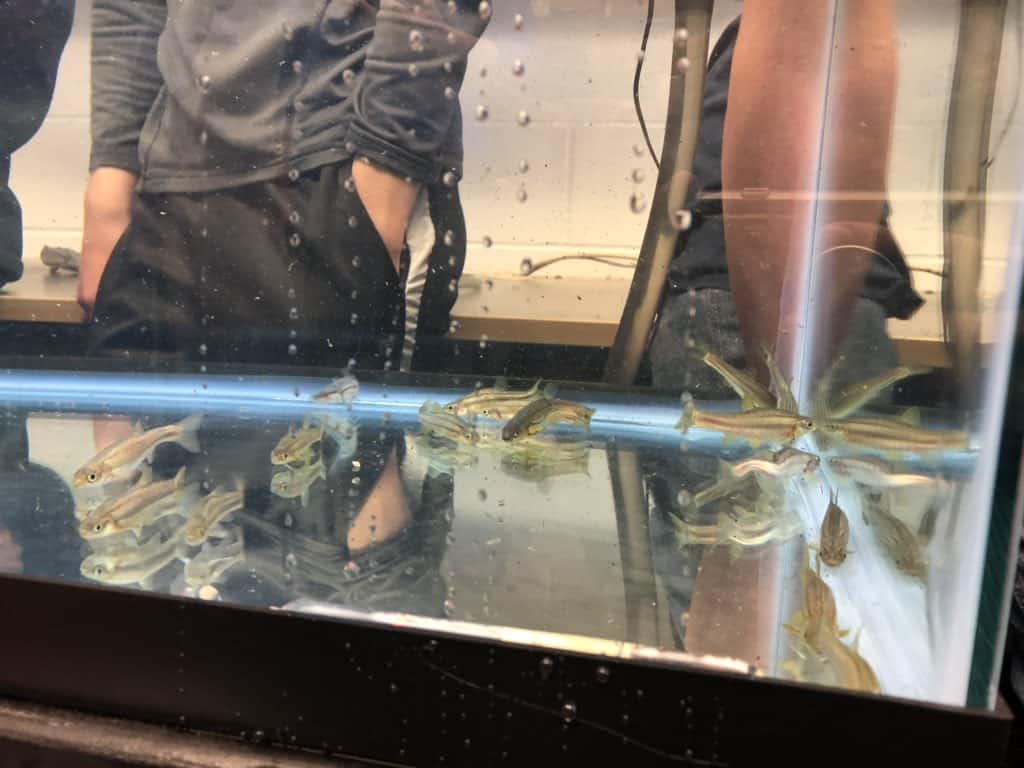
As a result of the 2013 Colorado Front Range Flood, the native Northern Redbelly Dace was adversely affected by overflowing sediment that altered its habitat in local ponds. The fish, classified as a Tier 1 Species of Greatest Conservation Need, are considered endangered in Colorado because of low population numbers. By pairing students with biologists, an innovative recovery project aims to raise and successfully breed 100 redbelly dace, the offspring from which will be used to reintroduce the species locally.

To kick off the project, members of partnering organizations visited the John W. Mumma Native Aquatic Species Restoration Facility in Alamosa, recognizing the opportunity to teach students about conservation and environmental biology in a hands-on environment while helping to restore the population of a fish indigenous to the St. Vrain. Both Lyons Middle Senior High School and the Innovation Center of St. Vrain Valley Schools created student teams to work on the project, with plans to collaborate through an online Schoology course.

“We thought that this would be a great opportunity to make a connection with the Innovation Center and have our students work on a project together,” said Colleen Ford, Assistant Principal at Lyons Middle Senior. “The goal is to help our students understand how science relates to their real world and their environment.”

At Lyons, students in the Science and Leadership program focused on water quality tests, feeding, and research to help determine the best environment for raising the fish and getting them to spawn. Through the Innovation Center’s Applied Robotics Conservation through Technology class, students focused on learning how technology can be applied to monitoring, regulating, and rehabilitating habitats.

In early March, Colorado Parks and Wildlife delivered 100 redbelly dace from Alamosa — 50 to Lyons Middle Senior, and 50 to the Innovation Center. The project was off to an exciting start when the coronavirus pandemic forced school buildings to close in mid-March and students transitioned to remote learning. Dr. Mikki McComb-Kobza, Executive Director of Ocean First and project mentor for the students, set up multiple tanks in her basement and relocated the 100 fish to her home.

“Students were able to stay engaged with the fish because Dr. McComb-Kobza set up a webcam,” said Nyko de Peyer, technology education teacher at the Innovation Center. “They continued to work on projects focused on conservation and communicated what they were learning with technology.

Through WebEX meetings, McComb-Kobza provided updates on the fish and their reproduction. She also excitedly shared the updates on social media.

In late May, the redbelly dace began to lay eggs, offering hope for the continuation of the project. Though the project looks different than originally planned, the fish spawned seven times this summer, an encouraging sign for conservation efforts. 

The redevelopment of a pond at Pella Crossing by Hygiene has also faced unexpected challenges, so the fish will be released into a compatible habitat on a private property in Lyons on August 26. Once moved to their new home, the students will help manage the pond to encourage a successful transplant. If the fry successfully develop to adulthood, they can be reintroduced to the St. Vrain River.  If successfully reintroduced to the wild locally, Colorado Parks and Wildlife can attempt additional transfers throughout the state.

Ford hopes to continue to connect the project to other science classes at Lyons, including a ninth grade biology class learning about microplastics, a tenth grade chemistry class checking water chemistry in local streams, and an AP environmental science class. Once released into the wild, the Innovation Center students can utilize innovative technologies to look at the parameters of the habitat, like using underwater cameras to monitor and regulate the environment.

“The overall goal is to continue to increase the population of redbelly dace to the point where they can thrive in one of their former natural habitats,” says de Peyer. “They are also an indicator species, so they can help tell if the watershed is being polluted, or is unhealthy. Reintroducing this species is important in helping inform what is going on in their ecosystems.”

Student Engineers Tackle Real-World Challenges During Summer Bootcamp

On a hot July afternoon when many students might have been out for a socially-distanced bike ride or dipping their toes at a local pool, 18 St. Vrain Valley Schools middle and high school student engineers were busy collaborating virtually to design and prototype solutions to some of our world’s most pressing challenges.

As part of the PYNQ Bootcamp, hosted at the Innovation Center in partnership with Xilinx, students engaged interns and engineers to explore Python coding, computer science, and embedded systems – the primary components of Xilinx’s product, PYNQ. Students leveraged those technologies to prototype and design innovative products and engineering solutions. Students created small teams that focused on designing solutions within healthcare, smart textiles, or the aerospace industry. At the culmination of the camp, students presented their ideas to a panel of judges in a virtual showcase of their learning.

“Being from a computer science engineering background, it was great exposure for me to learn some electrical engineering along with students,” shared Anshul Dabas, an intern with Xilinx. “In my opinion, it was a huge platform for school kids, one that helped them dive into programming and robotics related applications.”

For rising Niwot High freshman, Taryn McDermid, the camp provided much more than an opportunity to engage in learning advanced technologies.

“What I enjoyed the most was the opportunity to work closely with other students in a virtual environment to discuss different ideas we had for addressing challenges we see in our lives today,” shared Taryn. “We focused on the coronavirus pandemic, and specifically on the challenges of schools, healthcare providers, and other organizations in efficiently conducting temperature checks and monitoring symptoms.”

Taryn was part of Team Health Guard, a collaboration of four young women engineers who developed a product prototype for a face shield (for healthcare workers) and a hat (for the general population) that included a temperature sensor that would remain in contact with the wearer’s forehead and would signal through LED lights and an auditory alert if the person had an elevated temperature.

“Each member of the team took a different role, based on our strengths, such as coding, prototype sketching, project management, and design,” added Taryn. “We also did a lot of testing after we wrote the code and adjusted as we went. I think an interesting future application could be a product that has the LED lights embedded right into the hat so that as students are walking into a school, teachers could see right away if someone had an elevated temperature.”

Other student team product innovations included: an exploration of image file and data transmission that could be used on robots on Mars; sensors to monitor temperature and humidity on spacecrafts; using sensors to give patients more control of their hospital room environment; data visualizations for COVID-19 tracking; a body temperature scanner; and exploring temperature and humidity sensors for extraterrestrial agricultural operations.”

As a college student, I’m able to witness and participate in all kinds of technological innovation,” shared Xilinx intern, Dustin Ramsay. “What really inspires me, however, is to see the same caliber of innovation and creativity happening at the middle and high school level. It makes me hopeful for the future.”

Partnerships are essential to supporting these types of learning opportunities for students. In addition to learning from industry experts, Xilinx provided students with their own PYNQ board, as well as additional equipment like a camera and multiple sensors.

“Xilinx was thrilled to partner with the SVVSD Innovation Center again on the PYNQ Bootcamp project,” added Xilinx employee, Mindy Brooks. “It’s important to Xilinx that we give back to our community, not just with monetary funds but also by investing our time and energy in the students, which are our future workforce. Xilinx looks forward to our continued partnership with St. Vrain Valley Schools and the Innovation Center.” 


If your organization is interested in engaging the Innovation Center or Career Development Center in developing virtual learning experiences – virtual tours, webinars, career talks – complete the Community Strong engagement form.

National Science Foundation Awards FRCC and SVVSD $494,175 to Open a Cybersecurity P-TECH Program

Front Range Range Community College (FRCC) and St. Vrain Valley Schools have been awarded a $494,175 grant from the National Science Foundation (NSF) to support the opening of a Pathways in Technology Early College High School (P-TECH) program in cybersecurity. The grant was awarded as part of NSF’s Advanced Technological Education (ATE) program, which focuses on education for high-technology fields that drive the nation’s economy.

The new cybersecurity P-TECH will allow students to earn an associate degree alongside their high school diploma—at no cost to the student. Students will apply to begin the program in ninth grade and graduate within four to six years. The initiative will include FRCC, St. Vrain Valley Schools, and a collaboration of industry partners including Seagate, Cisco, and Comcast.

“We’re thrilled to be included in this project. We need young, talented people in the cybersecurity industry and this is an innovative way to get there,” shared Joan Motsinger, Senior VP of Business Excellence at Seagate. “Working locally with high school students and helping to prepare them for future opportunities in technology is exactly what is needed today.”

The vast majority of cybersecurity jobs require at least an associate degree. To address the skill needs of businesses, the course of study for the new P-TECH program will be developed in close collaboration with industry partners. Students will receive significant work-based learning opportunities—including work site visits, mentoring with industry mentors, and paid internships.

Front Range Range Community College (FRCC) and St. Vrain Valley Schools have been awarded a $494,175 grant from the National Science Foundation (NSF) to support the opening of a Pathways in Technology Early College High School (P-TECH) program in cybersecurity. The grant was awarded as part of NSF’s Advanced Technological Education (ATE) program, which focuses on education for high-technology fields that drive the nation’s economy.

The new cybersecurity P-TECH will allow students to earn an associate degree alongside their high school diploma—at no cost to the student. Students will apply to begin the program in ninth grade and graduate within four to six years. The initiative will include FRCC, St. Vrain Valley Schools, and a collaboration of industry partners including Seagate, Cisco, and Comcast.

“We’re thrilled to be included in this project. We need young, talented people in the cybersecurity industry and this is an innovative way to get there,” shared Joan Motsinger, Senior VP of Business Excellence at Seagate. “Working locally with high school students and helping to prepare them for future opportunities in technology is exactly what is needed today.”

The vast majority of cybersecurity jobs require at least an associate degree. To address the skill needs of businesses, the course of study for the new P-TECH program will be developed in close collaboration with industry partners. Students will receive significant work-based learning opportunities—including work site visits, mentoring with industry mentors, and paid internships.

“Cybersecurity is critical to almost every industry,” said FRCC President Andy Dorsey. “That’s why jobs in this arena are plentiful in Colorado—and they pay well. When our P-TECH students complete the FRCC cybersecurity program, they’ll be highly qualified to get good jobs right out of high school.”

This is the third P-TECH program in St. Vrain Valley Schools and the second developed in partnership with FRCC. Through this program, FRCC and St. Vrain are working to increase Colorado’s workforce capacity in cybersecurity and other tech industry sectors. According to a 2019 report by the Center for Strategic and International Studies, the U.S. currently faces a cybersecurity workforce shortage of about 314,000 workers out of a total national cybersecurity workforce of 716,000—and by 2022, that gap is expected to reach 1.8 million unfilled positions.

This unique P-TECH program is designed to increase diversity in the cybersecurity workforce pipeline by recruiting students earlier in their educational careers. It will also increase student engagement and workplace success skills by providing meaningful industry work experiences, and improve student preparedness by providing industry-aligned coursework.

“We are creating opportunities that are not only giving our students a strong competitive advantage for their future, but also supporting a robust technology industry and a thriving economy in our community,” said Don Haddad, Ed.D., Superintendent of St. Vrain Valley Schools. “We are incredibly appreciative of our partnership with Front Range Community College and our industry partners, such as Seagate, Cisco, and Comcast, in working together to address the growing need for a strong cybersecurity workforce.”

The Cybersecurity P-TECH program will be housed at Silver Creek High School and student recruitment will begin this fall. The first-year cohort of 30-35 students will be enrolling in fall 2021, a second year cohort of 30-35 students in fall 2022, with future cohorts increasing to 50-60 students per cohort (based on student demand).

“We are excited to work with St. Vrain Valley Schools and Front Range Community College in developing a new workforce pipeline in cybersecurity,” said Nick Nielsen, Fellow at Comcast. “Cybersecurity touches just about everything we do—we need more people with skills and training to protect our online information. This is a perfect way to start young people on a fun, interesting, and important career pathway.”
“Cybersecurity is critical to almost every industry,” said FRCC President Andy Dorsey. “That’s why jobs in this arena are plentiful in Colorado—and they pay well. When our P-TECH students complete the FRCC cybersecurity program, they’ll be highly qualified to get good jobs right out of high school.”

This is the third P-TECH program in St. Vrain Valley Schools and the second developed in partnership with FRCC. Through this program, FRCC and St. Vrain are working to increase Colorado’s workforce capacity in cybersecurity and other tech industry sectors. According to a 2019 report by the Center for Strategic and International Studies, the U.S. currently faces a cybersecurity workforce shortage of about 314,000 workers out of a total national cybersecurity workforce of 716,000—and by 2022, that gap is expected to reach 1.8 million unfilled positions.

This unique P-TECH program is designed to increase diversity in the cybersecurity workforce pipeline by recruiting students earlier in their educational careers. It will also increase student engagement and workplace success skills by providing meaningful industry work experiences, and improve student preparedness by providing industry-aligned coursework.

“We are creating opportunities that are not only giving our students a strong competitive advantage for their future, but also supporting a robust technology industry and a thriving economy in our community,” said Don Haddad, Ed.D., Superintendent of St. Vrain Valley Schools. “We are incredibly appreciative of our partnership with Front Range Community College and our industry partners, such as Seagate, Cisco, and Comcast, in working together to address the growing need for a strong cybersecurity workforce.”

The Cybersecurity P-TECH program will be housed at Silver Creek High School and student recruitment will begin this fall. The first-year cohort of 30-35 students will be enrolling in fall 2021, a second year cohort of 30-35 students in fall 2022, with future cohorts increasing to 50-60 students per cohort (based on student demand). 

“We are excited to work with St. Vrain Valley Schools and Front Range Community College in developing a new workforce pipeline in cybersecurity,” said Nick Nielsen, Fellow at Comcast. “Cybersecurity touches just about everything we do—we need more people with skills and training to protect our online information. This is a perfect way to start young people on a fun, interesting, and important career pathway.”
St. Vrain Valley Schools