Education Today: Virtual Reality and District Finances

Catch up with the latest episode of Education Today, featuring Altona Principal, Jeremy LaCrosse and Sasha, an eight grade student who uses virtual reality and technology integration throughout her school day at Altona.

St. Vrain Superintendent Don Haddad meets with Altona Middle School Principal Jeremy LaCrosse and eighth grade student Sasha.

St. Vrain Superintendent Don Haddad meets with Greg Fieth, Chief Financial Officer.

SAT Prep Steps: How much should I practice for the SAT?

SAT Prep Steps

Practice Makes Progress

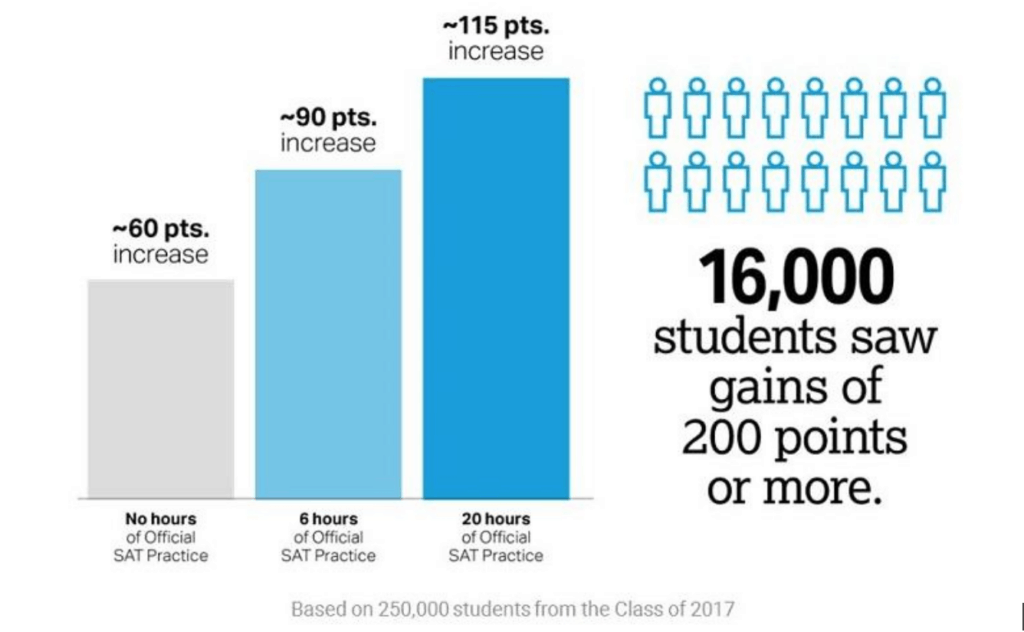
Just this week, a student saw this graphic and said, “Are you serious? If I want to go up 100 points, I have to practice for 20 hours?!” And yes, at first that numbers seems jarring, considering how much students have going on these days. But when I pointed out that we have about four months to prep, and that really amounts to a little over 1 hour a week, his response was, “Legit. I can do that.” And when we considered that no sport would ever boast a one-hour practice schedule (they’re usually hours a night, not including games), it seemed even less imposing.

This assessment coming up in April is unique to other things you’ve done in class. Your goals will be different, your strategies should be different, and the timing is different. You have to practice differently to play differently.

Not all practice is created equal – just clicking mindlessly through Shmoop or Khan for an hour a week isn’t probably going to help much. BUT – if you work through Shmoop/Khan/SAT questions, write notes to follow up with teachers about, be intentional and deliberate about developing weaknesses and refining strengths, and pair that with independent, personalized reading, timing, and math strategies, you can make a significant improvement in your score. And now we’re talking beyond SAT prep- these are just great life habits!!

This practice is in addition to homework and class time; you have to practice SAT-like problems. If your goals require a higher increase, practice more. Practice will expose you to the exact types of questions you’ll see (they never change); the exact amount of questions in the same time period (it never changes); and the exact level of complexity posed by the assessment (again – never changes). And – you’ll also be reading while you do it, so reading for the win!

Students

  • When: Identify a time and put it in your calendar. You don’t just “have” time laying around for this – you have to create the space to make it happen. When could you carve out an hour to devote? When are you most productive and awake? Set realistic goals based on your own habits and behaviors.
  • Where will this practice take place? Sometimes your bedroom isn’t the best place – because it’s so comfortable, you can be too relaxed. Consider a library, coffee shop, or other location with a slight distraction/ maybe even uncomfortable chair factor.
  • How: Are you set up with the right materials? Log into Shmoop (all SVVSD students have accounts) and Khan Academy. SAT has 8 official practice tests free online here and/or buy/ borrow this book. There’s also a daily practice app. When you’re practicing, time time yourself. That clock freaks everyone out – practice with a timer and get used to it. You’ll thank yourself on game day.

Teachers

  • If a student asks you how they could improve, looking at their in-class performance is a first start. Since the SAT suite of assessments are aligned to Colorado Academic Standards for English and Math, you’ve got a great start getting them ready. Are there any papers they could take a closer look at regarding organization or structure? Any relevant math work they struggled on? How do they do on word problems or reading graphs and charts? Those are great indicators.
  • Keep a sign visible with directions for logging in to Khan or Shmoop. Remind them frequently to use these resources.
  • Encourage students to read an article a night in any content. They’ll need literacy skills across the spectrum for this assessment. How could they share their learning with their peers? Science teachers can help a lot here too since many articles in the SAT include graphs and charts.
  • Identify a location in your school where students could set up a practice club. Ideally a location where they will always have access to a device and SAT materials. The library is always a great place, and maybe even identify certain times when someone could be on hand to answer questions – a practice club might encourage students who are intimidated to practice on their own. And help doesn’t have to come from a teacher! Other students who are experts in their content could volunteer to be available.

Does this raise any questions, comments, or suggestions for other students you may have about this? Post them on Twitter, Facebook, or email [email protected]!

School Culture Drives Student Safety

It is no secret that St. Vrain Valleys Schools values cutting-edge technology, high-quality teachers and academic excellence within its schools. These essentials are considered ‘priority one’ when speaking to any district official or community stakeholder. Another area of equal importance is student safety and providing secure learning environments for our community’s greatest asset – students.

With the successful passage of two bond measures and strong finances, St. Vrain remains dedicated to investing in safety and security. Over a span of eight years, the school district has allocated $4.2 million to facility improvements such as secure entryways, indoor and outdoor camera systems, school resource officers (SROs) and upgrades related to increased emergency response times. In addition to building upgrades, students and staff engage in several trainings and drills throughout the year – averaging 811 drills across all schools annually and 1,890 hours of training designated for campus supervisors, SROs, school leadership and district administration.

Every camera installed and every drill performed greatly increases our ability to provide safe learning environments, but by far, the greatest asset we have in responding to critical situations is the culture created within the classrooms and hallways of our schools.

Staci Stallings has been an SRO at Silver Creek High School for the past three years of her ten-year tenure with the Longmont Police Department. She fully believes that a strong, well-defined culture contributes to school safety. “The term school safety is often associated with prevention. When I think of school safety, I think of a student’s mental health, the quality of life in school and relationships developed between students,” said Stallings. “These issues affect school safety and can be linked to documented incidents of school violence.”

Overall, St. Vra in Valley Schools has 13 dedicated SROs servicing all neighborhood schools and the 411 square miles surrounding them. While these officers ultimately serve the community by enforcing the law, they are an integral part of school culture and discipline – they must be approachable. “The key is to rema in visible – I never stand alone. There are always kids conversing in the halls or at lunch. I use that time to ask questions and get to know as many students as I can.”

When Stallings is not cruising the halls or having lunch with incoming freshmen, she can be found participating in classroom discussions, accompanying classes on leadership retreats, attending co-curricular activities or overseeing Silver Creek’s Restorative Justice (RJ) Program, a program designed to engage students on both ends of an infraction – the ‘offender’ and the ‘victim’. Stallings successfully established the RJ Program during the 2016-2017 school year, with the support of the Longmont Community Justice Partnership (LCJP). When used, RJ is a highly effective, alternative form of discipline that engages all parties involved and allows for a healthy emotional healing process. To start the process, the ‘offender’ must first take responsibility for his or her actions. Once this is acknowledged, the ‘victim’ and his or her parents or guardians must agree to participate in a group conference. This conference involves both parties, staffed facilitators and LCJP trained student peers. Collectively, the group decides action items for the ‘offender’ to complete. This could consist of a written apology, a published article on a meaningful topic or any other constructive form of contrition. Once all action items are completed, offenders are eligible for reduced punishment while victims experience a more meaningful resolution.

The RJ Program is not the only initiative impacting Silver Creek’s school culture and safety. Sources of Strength (SOS) is a national project that encourages students to develop help-seeking behaviors and promotes connections between peers and caring adults. Interventionist Whitney Mires was first exposed to SOS at a Colorado Safe Schools Conference.

“Sources of Strength is a community oriented program that concentrates on positive solutions rather than the ‘sad, shock and trauma’ approach often used in programs supporting mental health,” said Mires. “The goal is to reach all of our students with this program, not just those within select focus programs.”

Through a large grant from Boulder County Public Health, the school was able to host an initial training of 50 students and 12 staff members in the fall of 2016 with plans to host a second training this fall. During the second year of this initiative, new recruits are nominated by peer leaders from the previous year and they participate in group informational meetings, one on-one conversations and campaign development activities. Senior, Aubrey Hanrahan, feels so strongly about the SOS program, she’s made it her senior capstone project for Silver Creek’s Leadership Academy. Hanrahan is a valuable peer leader and looks forward to further integration of SOS in the school’s culture.

“It is a positive program that focuses on supporting students,” said Hanrahan. “Many of my friends currently trained in the program feel genuinely supported and realize there are ways in which they can reach out for help if they need it.” SOS has a large inventory of predesigned materials to guide student-led activities, but schools are encouraged to adjust their program based on their school’s culture and level of participation. Silver Creek’s program utilizes posters, videos, audio recordings and social media content by producing various campaigns that target specific challenges students often face – depression, anxiety and anger, to name a few. Each campaign uses images of actual Silver Creek students and focuses on how they deal with these common emotions. This increases relatability and drastically improves the school’s efforts in recruiting new students and peer leaders. Schools are encouraged to share their efforts with other schools in their community and across the nation.

Social-emotional programs such as Sources of Strength and Restorative Justice have proven successful within St. Vrain, prompting the district to develop additional strategies for continuous improvement. These include increased student participation and engagement at school, strengthening emotional support and stress management, and emphasizing healthy habits and behaviors.

During the 2015-2016 school year, St. Vrain implemented its first ever Wellness, Culture and Safety Inventory (WCSI), an online questionnaire that collects feedback from high school students. The inventory takes approximately 30 minutes to complete and focuses on student well-being and issues that impact academic performance and success.

Results from the 2016-2017 WCSI questionnaire revealed that most high school students feel very secure and safe in their school environments. They like and feel connected to their schools, have many chances to be involved and feel very strongly that graduation and having plans for the future are extremely important.

Another tool in St. Vrain is Safe2Tell, a Colorado organization serving as the statewide bystander reporting tool for concerning behaviors. Safe2Tell encourages individuals with critical information about a possible event to report it.

Susan Payne, Founder and Director of Safe2Tell believes an increase in the number of tips received each year demonstrates a change in the culture and attitudes about reporting unsafe behaviors and situations. Over the past ten years, social norms have changed. Payne says, “It is imperative that we lower the threshold of what triggers a student report or anonymous tip. Notifications of the smallest concern contribute to the safety of students and staff.”

Children are exposed to higher amounts of communication through social media and other online platforms. While it is impossible to monitor every scrap of information a student receives, it is possible to encourage reporting, build social-emotional skills and provide the tools necessary to inform authorities in a comfortable way.

“Young people perceive threats to school safety long before adults,” said Payne. “It is extremely important for students to recognize the importance of reporting suspicious activity to an adult or through the Safe2Tell hotline.” St. Vra in Valley Schools, had many reports in the 2016-2017 school year. These reports ranged from bullying to petty theft, but show that students are willing to report and build upon the life skills and resiliency programs they are engaged in.

Just as St. Vrain has experienced tremendous success in developing strong academic programming, integrated learning technologies and professional development, it has succeeded in cultivating a culture of school safety, positive outlooks and interconnectedness.
Community partnerships have significant impact on focus programs

Reading, ’riting and ’rithmetic? Think energy production, bioscience and visual and performing arts. These are just a few examples of the rigorous coursework offered by “focus academies” in St. Vrain Valley Schools’ high schools.

Focus academies are designed for high school students interested in a specific career to learn not only about the fundamentals, but to learn from professionals who work in the field as well. There are currently seven focus academies offered in St. Vrain. These focus academies include college preparatory and specialized instructional programs that work closely with business, community and academic partners to bring depth and expertise to the classroom.

Energy Education in Mead

Alain Valette, dean of students at Mead High School, is the coordinator for the new Mead Energy Academy. This year, 25 students are enrolled in the flagship class about the principles of energy. Valette said next year, more than 60 students are registered for the academy, which is doubled expectations.

“One thing that was important to Mead when we created this program was that it should be accessible to all students,” said Vallete. “We want the Energy Academy to be for students looking at four-year colleges, two-year colleges and those going straight into the workforce. Our intent is to prepare students for all kinds of jobs in the energy and energy-related industries.”

Strong external partnerships provide a foundation for Energy Academy students to apply rigorous academic knowledge to industry applications. Two geologists visit the school on a weekly basis to discuss scientific research, industry trends and how important math skills are in their daily operations. Partners such as Annadarko, Silicon Ranch, Solar City, Tri-State Generation and Transmission Association, and United Power also support initiatives such as equipment acquisition, field trips and a career fair.

“We are a very broad-based energy academy that teaches from a balanced approach that includes societal, economic and environmental perspectives,” Valette said. “We are always looking for new partners that can help us educate and inspire students to tackle the energy challenges of the future.”

Visual and Performing Arts at Skyline

Focus academies are leveraging partnerships with universities and colleges as well. These partnerships are helping students “bridge the gap between high school and college,” said Stephanie Texera, director of bands and performing arts coordinator of Skyline High’s Visual & Performing Arts Academy (VPA).

VPA has approximately 120 students currently enrolled, with 60 new applicants for next year coming from schools around the district. Focus academies “create lasting professional relationships between students and their possible future mentors and professors,” Texera said.

For example, the Skyline Jazz Band has an ongoing partnership with the Thompson Jazz Studies department at the University of Colorado Boulder, and the academy has partnered with the CU-Boulder eCSite program, which explores the crossover between computer science and visual arts. Other partners have included the United States Air Force Academy Chamber Winds ensemble and guests from the music education faculty at Colorado State University. This spring, renowned vocal jazz pedagogue Kerry Marsh from University of Northern Colorado will hold a clinic for the Alpine Vocal Jazz ensemble, and Skyline students will work with voice faculty from the University of Wyoming. The Visual Arts Department also partners with local businesses and organizations, including the Longmont Museum, Sun Rose Café, the Latino Chamber of Commerce and Arts Longmont for exhibits and visiting artist series.

Jennifer McLees, a visual arts teacher and visual arts coordinator, said this year the academy is inviting several colleges to review student portfolios, and the recruiters will in turn share valuable information about the benefits of attending these post-secondary institutions.

Medical and BioScience at Longmont High

Focus academies are also benefitting the greater community. For example, last year a group of students enrolled in Longmont High’s Medical & BioScience Academy (MBSA) worked with a University of Colorado bioengineering professor to design an assistive device for a disabled student, said Chris Chou, an AP biology teacher and MBSA program coordinator. Students partnered with a university researcher, learned about the challenges of the disabled and worked on an engineering project in which they developed new skills and learned how to use a 3D design program and 3D printer.

Chou said some MBSA students know they want to be healthcare professionals or conduct scientific research, while others simply want to explore career options. Coursework includes introduction in the foundations of healthcare, nutrition and wellness, anatomy and physiology, forensic science and a bioethics class. During their senior year, students participate in a semester-long internship or complete a senior capstone project. Past topics have included neurology, cardiology, radiology, emergency medicine, nursing, physical therapy, public health and speech therapy. At the end of the year, MBSA interns present their projects at a poster session, which is open to the public, so they can practice their public speaking skills to a varied audience.

“MBSA students might one day graduate from medical school or engineering programs and come back to work for local companies,” Chou said. “Some of the students who interact with our university partners might continue on to get a Ph.D. in science, pursue scientific research and find a cure for cancer or develop a vaccine to prevent deadly diseases. These partners are investing time, energy and effort in these students, who will be our future leaders in medicine, science and the community around us.”

MBSA partners include CU-Boulder, CU-Denver, CSU, IBM, Longmont United Hospital and Medtronic. MBSA students hear from corporate guest speakers and they have the chance for job-shadowing and mentorship.

“Through focus academic like these, students have the opportunity to see, hear, experience and learn about many aspects of these jobs – both the positive and negative aspects,” Chou said. “They are able to receive a realistic view of what it takes to make it into these fields and the education and skills needed to be successful.”

St. Vrain Valley Schools