SVVSD students learn about democracy from community leaders

May 1, 2019, 3:25pm  |  St Vrain Valley School District
By Amy Bounds, Staff Writer, Times-Call

About 65 St. Vrain Valley eighth graders came together with community leaders Tuesday to wrestle with difficult problems and develop solutions through the Doing Democracy Day program.

“We want to teach them how to be engaged citizens and learn how policy is made,” said Emily Swallow, a social studies teacher at Altona Middle School. “They can have their voices heard and listen to other voices.”

The program, now in its 10th year, offered both a middle school and a high school session this year, both at St. Vrain’s Innovation Center. This was the first year for a middle school event.

Kent Willmann, an instructor the University of Colorado Boulder’s School of Education, was one of the founders of Doing Democracy Day when he was teaching social studies at Silver Creek High School. The event, the brainchild of CU political scientist Ken Bickers, is designed to spark student interest.

St. Vrain, with a decade of momentum, is on a “high-tech high” that’s gaining national attention for its students and teachers

April 30, 2019, 2:38pm  |  St Vrain Valley School District
By Christopher Osher, Colorado Sun

Innovations that emphasize real-world experience have northern Colorado students working on everything from rescuing endangered frogs in Peru to using drones to deliver mail
 

Eric Berngen realized just how different a learning environment he had signed up for when he almost stepped on a small robot zooming down a hallway at Skyline High School in Longmont  during his first week on the job.

“It was surreal,” Berngen recently said of the near collision with the robot a student was operating that day nearly three years ago. “It was just a high-tech high going on at the school.”

Berngen moved in May 2016 from the urban density of Chicago to the wide expanses of northern Colorado to become part of an innovative new program at Skyline that merges public high school education with industry and higher education. Students participating in Berngen’s program can earn a high school degree as well as an associate’s degree in applied science in computer information systems.

To understand just how different things are at Skyline, you also should know this: Even though Berngen works at Skyline four days of the week, he isn’t employed by the school. Nor is he an employee of the St. Vrain Valley School District, where Skyline is located. He works for IBM, as the education program manager for the company’s Boulder County operations.

He’s part of a new approach to education championed by St. Vrain, which in 2007 launched a series of academic innovations that have made the district the envy of public education administrators across the nation. It’s a learning philosophy rooted in combining forces with local colleges and businesses to give students high-tech skills that prepare them for work in highly technical and skilled jobs, a segment where growth is projected to continue.

Students get real-world experience in such areas as robotics, video production, entrepreneurship, computer science, aeronautics and biomedical engineering. Students pitch ideas to industry and community partners and some get hired to solve intractable problems as they earn college credits.

The changes have helped dramatically increase graduation rates among some of St. Vrain’s most disadvantaged students, school administrators say.

Projects impact Peruvian frogs, Brooklyn poets and stranded hikers

“The rigor is there,” Berngen said. “The push is there, and the opportunity for engagement is there and the supports are there. When all of those pieces of the puzzle are there, you’re going to have opportunities for outstanding student success.”

In all, the school has enlisted about 100 industry partners who rely on students to work on projects for them. The specialized programming has spread throughout the district. But a select group of about 100 of the participating students are being paid by those industry partners, or by the district, for specialized work, including the repair of school computers

One student team has built an underwater robot that officials at the Denver Zoo plan to use to help international biologists rescue an endangered frog species in Peru. Plans are underway to develop robotic prosthetics for injured zoo animals. Another group of students is designing drones that will handle school-district deliveries and take aerial photos for local real estate firms. Taylor Mali, a Brooklyn-based poet and educator, has deployed another set of students to create an iPhone app that will generate metaphors he can use for his slam poetry performances.

“These students, they are champing at the bit,” says James Garcia, an environmental educator with the Denver Zoo. “They want to be a part of something. They want to put their hands on something and build something.”

Garcia provided the students zoo grant money for them to build an underwater exploratory robot that he plans to take to Peru in May to help him document the devastation of the Telmatobius culeus frogthat inhabits Lake Titicaca.

Last year, the Lemelson-MIT program, administered by the Massachusetts Institute of Technology, awarded a St. Vrain student team $10,000 to develop an emergency, portable beacon system that uses drones to locate and take video of people stranded in the mountains.

Such unique projects are attracting notice.

Last year, St. Vrain hosted 165 tours of its facilities, most for school officials from outside the state seeking to replicate the district’s approach. This year, the district is on a pace to far exceed that number of tours.

“We definitely have a national spotlight,” said Patricia Quinones, St. Vrain’s assistant superintendent of innovation. “They come from all over the country, whether it’s other school districts, industries or nonprofits. They are coming to just kind of gain some understanding of what our model looks like.”

Last year, St. Vrain took home the prize considered by many in academia to be the top award for technology education: The district team award from the Consortium for School Networking, the premier national association for school tech leaders. St. Vrain beat out thousands of other districts, earning praise for a system-wide approach and for having the most e-book and audiobook downloads of any school district competing for the award.

Flashback: STEM focus came from worries over aging school

Quinones was principal at Skyline High School in 2007, when the district — worried about the impact of a new high school across town on the aging northeast Longmont school — put itself on the path to push students to learn skills in science, technology, engineering and math, or STEM.

Nearly 64 percent of the students at Skyline were minorities and nearly 45 percent of the students were on free or reduced lunch programs. Quinones went online and learned all she could about the emerging STEM education trend, which calls for more critical thinking and application and less memorization.

“We came up with the concept of developing programming within the school that would cause the kids to be attracted to the school,” Superintendent Don Haddad said.

Skyline opened a STEM Academy and a Visual Performing Arts Academy that year. In 2009, the school district won a $3.6 million investing in innovation fund grant, also known as an i3 grant, from the U.S. Department of Education to help it develop the STEM Academy.

The work involved changing the vocabulary of education at Skyline, using techniques popularized by Stanford University’s prestigious D.School.Teachers and students were trained in the Stanford process. They problem-solve by first learning to empathize with those needing a problem solved. They learned how to define the problem and brainstorm solutions before moving on to prototypes. They also learned that the development of a solution or project isn’t the end, and that followup work is necessary to determine if the proposed solution is working and if not, why it is failing. The Stanford thinking has become so embedded in St. Vrain’s culture that it’s now even part of the approach used when teachers and parents meet to discuss issues.

In 2012, St. Vrain became one of the 16 school districts in the nation awarded a highly competitive Race to the Top grant from the U.S. Department of Education. That $16.6 million grant helped St. Vrain spread the STEM Academy concept beyond Skyline to other schools in the district.

Voters in the district, which includes 32,000 students in Boulder, Weld, Broomfield and Larimer counties, also have passed two mill levy overrides to raise money for operations and two bond initiatives to overhaul existing schools and build new schools. Now, STEM elements are in use  in more than 60 schools in the district, including two preschools that specialize in the approach.

The approach has become so far-reaching that St. Vrain third graders recently joined forces with the Longmont Museum to identify problems facing the local area and come up with possible solutions. The student suggestions are on display at the museum now. An app allows the students and their parents to get audio and video presentations on their cell phones of all that work.

The latest bond initiative also allowed St. Vrain to build a new 50,000-square-foot, $20 million innovation center that opened last year.

The new gleaming glass and steel St. Vrain Valley Innovation Center on Quail Road, near the Longmont Museum and a new recreation center, is modernity taken to the max. The center’s architecture of sharp, jutting angles screams Silicon Valley. Inside, along with lab spaces for robotics, computer programming, aeronautics, video and audio production, there’s also a $230,000 flight simulator, that was donated by Ames Community College. A huge aquarium filled with colorful, exotic fish allows students to test the aquatic robots they are developing. Upstairs, there’s a “pitch room,” complete with a long conference table, where students offer ideas to industry leaders and some end up signing contracts for deliverables.

Last year, the district decided to take its STEM programming on the road, hiring Farber Specialty Vehicles of Ohio to develop a 45-foot long mobile lab, at a cost of about $800,000, 30 percent of which will be covered by local businesses. Inspiration for the mobile lab came from Lockheed Martin’s Mars Experience bus, a virtual reality bus at the Smithsonian’s National Air and Space Museum that replicates the Martian landscape. Instead of Mars, St. Vrain’s customized motor coach will feature St. Vrain student projects.

“This is taking my creativity and turning it into a physical thing.”

On one recent day, students were excited as they showed a visitor to the innovation center their inventions and projects.

Avery Fails, 18, a senior at Erie High School, showed off the aerial cargo drone with a 7-foot wingspan that she helped create and talked about how she and other students were working on plans to use drones to handle the school district’s mail deliveries. Several real estate firms are on the verge of negotiating contracts with the students for drone projects, she added.

“This is taking my creativity and turning it into a physical thing,” Fails said.

She said she was “so psyched” that technology entrepreneur Elon Musk was working to send humans to Mars, and that she aspires to someday become a key player in Musk’s plans. She also said she wants to develop robotic prosthetics that could help injured animals.

Fails already has been accepted to attend the University of Colorado’s engineering program and has amassed enough higher ed credits at St. Vrain schools that’s she’s on track to get a master’s degree in mechanical engineering in five years instead of the typical six years.

Many others students in St. Vrain are earning credits for college courses. Administrators said programming at St. Vrain gave the class of 2018 the opportunity to receive over 10,000 college credits by graduation, course work that has the potential to save families millions of dollars in tuition costs, according to district data.

As the rigor of STEM work at St. Vrain has taken hold, students have responded.

The number of students participating in robotics competitions through the school district has increased 677%. Meanwhile, expulsions in the district have plunged to five last year from 34 in 2013. Graduation rates among Latino students are rising dramatically. In 2008, the graduation rate for Latino students at Skyline was about 65 percent, compared with 84 percent last year. Similar improvements have been logged for Latino students throughout the school district.

The statistics become more personal when you work with the students up close, said Berngen, who serves as a bridge between IBM and Skyline students enrolled in one of the state’s first P-TECH programs, or Pathways in Technology Early College High Schools. Students enrolled in that program can work toward getting an associate’s degree from Front Range Community College. They develop resumes, undergo mock interviews and learn how to sell themselves to prospective employers.

IBM provides more than 100 mentors to help an equivalent number of students enrolled in Berngen’s program.

He recalled how one student was struggling last year. He decided to give the student special attention and begin tutoring him after school.

“The amount of growth that happened in that student from the freshman to junior year has been absolutely incredible,” Berngen said. “It went from, ‘We don’t know if that student is going to make it,’ to the student becoming one of the top requested kids in the district for internship opportunities.

“It’s been amazing,” he said.

St. Vrain Valley School District Principal Named Colorado’s 2019 Elementary School Principal of the Year

April 29, 2019, 1:35pm  |  St Vrain Valley School District

Northridge Elementary School principal Lorynda Sampson was named the 2019 Elementary School Principal of the Year for Colorado by the Colorado Association of School Executives (CASE) and the Colorado Association of Elementary School Principals.

Sampson was chosen through a selective and competitive nomination process because of her hard work bringing Northridge Elementary from a Priority Improvement school several years on the clock, to a Performance status school, thanks to an ability to foster reflection and collaboration in her building.

“I’m shocked and honored,” Sampson said. “I’m so proud of my teachers, students and the entire Northridge community for coming together to challenge and improve our standards for the sake of our learners.”

Sampson established several collaboration efforts at Northridge to help teachers make instructional shifts needed to move their student achievement levels up. For example, she implemented video analysis tools in classrooms to help teachers celebrate their successes and analyze what was and wasn’t working as a team.

“As a principal who knows the power of shared leadership and collaboration, I needed to figure out how to shift the ownership of coaching from the principal to our staff while still increasing student growth and achievement, collective efficacy and collaboration through feedback and reflection,” she said.

“I made the practice of video observation and reflection public, safe and a celebration. By recording the staff celebration before winter break and having teachers celebrate by annotating the video together, the staff began to see that video was a safe way to celebrate what’s working, not just what isn’t.”

Sampson has also led efforts to improve parent and community member involvement at Northridge through a number of different measures, including offering monthly parent workshops in English and Spanish covering everything from healthy eating to technology and stress management, inviting parents to attend Classroom Conferences five times a year and establishing a Parent Leadership Team to provide input in school improvement goals and student data.

“Lorynda has been a force to be reckoned with at Northridge Elementary,” said CASE Executive Director, Lisa Escárcega. “Her focus and drive not only improved their CDE status; it’s also resulted in more STEM classes, a mentorship program and more effective teacher coaching.”

Northridge parents, staff and teachers also recognize Sampson’s hard work.

“The magic of working at Northridge Elementary is knowing that every person’s learning and progress is supported in a positive, caring environment. Mrs. Sampson is a positive life force for students, and our students know she will do whatever needs to be done to help them in learning and in life,” wrote seven Northridge teachers in a letter of support for Sampson.

“She will work tirelessly to solve problems, always with a smile and wink. It is an honor to work with our administrator and learning leader, Lorynda Sampson.”

Sampson will be recognized at a school event, as well as this month at the 2019 CASE Awards Reception. She will also be honored at the National Association of Elementary School Principals this July in Spokane, WA.

SVVSD digital specialist named an ’emerging ed tech leader

April 9, 2019, 10:36am  |  St Vrain Valley School District
By Amy Bounds, Daily Camera

Toni Hoehn’s efforts to educate students and teachers about digital privacy helped her win recognition as an emerging leader in education technology.

Hoehn, a digital curriculum support specialist in the St. Vrain Valley School District, was one of five female educators nationwide named as a “NextGen: Emerging EdTech Leader” on April 1 at the Consortium for School Networking, or CoSN, annual conference in Portland.

The EdTech Leaders Program — co-produced by EdScoop and CoSN — “recognizes up-and-comers in the K-12 education technology space who are making a difference,” according to EdScoop. Hoehn said she and the other four recipients plan to work together over the next year, sharing ideas and talking about how to troubleshoot common issues.

School Operating on a Normal Schedule for April 18

Dear St. Vrain Valley Schools Community,

Thank you for your support as we implemented school closures today alongside all Denver-metro area districts. This decision was made last night in consultation with the state’s Public Safety Office, representation from the Governor’s Office, and the FBI due to an ongoing school safety situation regarding a threat made by an individual toward local schools. As you may have heard in the local and national news, the person involved in the incident is deceased  and the FBI has assured us that there is no ongoing threat to the community.

To that end, St. Vrain Valley Schools will be operating on a normal schedule for tomorrow, April 18. Student safety continues to be our highest priority and we greatly appreciate the strong community support that has enabled us to implement numerous proactive safety measures in collaboration with our local law enforcement agencies.

As we move closer to the end of another successful year, I want to thank you for your continued partnership as we strive for excellence in serving our students, families, teachers and staff. I also want to thank our local law enforcement officers for their unwavering commitment to the safety and well-being of our students, teachers, staff, and community.

If you have any questions about today’s closure, please do not hesitate to contact your school directly. As always, you are also welcome to contact me directly.

Sincerely,

Don Haddad, Ed.D.
Superintendent, St. Vrain Valley Schools


Estimada comunidad de las escuelas del Valle de St. Vrain,

Gracias por su apoyo al implementar hoy el cierre de escuelas junto con todos los distritos del área metropolitana de Denver. Esta decisión se tomó anoche en consulta con la Oficina de Seguridad Pública del estado, la representación de la Oficina del Gobernador y el FBI debido a una situación de seguridad escolar en curso con respecto a una amenaza hecha por un individuo hacia las escuelas locales. Como puede haber escuchado en las noticias locales y nacionales, la persona involucrada en el incidente ha sido localizada y el FBI nos ha asegurado que no existe una amenaza continua para la comunidad.

Con ese fin, las Escuelas del Valle de St. Vrain estarán operando en un horario normal para mañana, 18 de abril. La seguridad de los estudiantes sigue siendo nuestra máxima prioridad y apreciamos enormemente el fuerte apoyo de la comunidad que nos ha permitido implementar numerosas medidas de seguridad proactivas en colaboración con nuestras agencias locales de aplicación de la ley.

A medida que nos acercamos al final de otro año escolar exitoso, quiero agradecerles por su colaboración continua mientras luchamos por la excelencia en el servicio a nuestros estudiantes, familias, maestros y personal. También quiero agradecer a todos nuestros oficiales locales de cumpliemento de la ley por su compromiso inquebrantable con la seguridad y el bienestar de nuestros estudiantes, maestros, personal y la comunidad.

Si tiene alguna pregunta sobre el cierre de hoy, no dude en comunicarse directamente con su escuela. Como siempre, también le invitamos a contactarse conmigo directamente.

Sinceramente,

Don Haddad, Ed.D.
Superintendente, Escuelas del Valle de St. Vrain

St. Vrain Valley Schools recognized for advancing our community

This month, St. Vrain Valley Schools was honored to be recognized as the Innovative Business of the Year by the Boulder Chamber and the Chair’s Choice Award from the Longmont Economic Development Partnership. St. Vrain Valley Schools’ strong public education system provides the foundation for preparing graduates to join society with a competitive advantage. St. Vrain is building vibrant communities and a thriving nation through its unwavering commitment to innovation and student success. 

The Boulder Chamber’s Innovative Business of the Year Award recognizes a business / organization that demonstrates the innovative spirit, creative problem solving, and pioneering approaches to organizational success and industry growth that exemplifies the character of Boulder’s business community. The Longmont Economic Development Partnership Chair’s Choice Award is selected by the Longmont EDP Board Chair to recognize an important partner and asset in the community contributing to the forwarding of Longmont’s economic development. 

From its nationally recognized Learning Technology Plan to the development of over 70 instructional focus programs, St. Vrain is giving students the skills necessary for advancement in a complex, globalized world. At the heart of this work are the strong relationships St. Vrain has built with leading industry partners throughout Boulder County and nationally. IBM, Google, University of Colorado, Elevations Credit Union, Seagate, LogRhythm, StickerGiant, and so many others come to St. Vrain to work alongside our community’s students, teachers, and education leaders to create and implement a vision for the future of education.  

Over the past decade, St. Vrain has experienced tremendous success and many educational achievements while still managing large enrollment growth. It helped to pass legislation that brought Pathways in Technology Early College High School (P-TECH) programs to Colorado and opened the state’s first P-TECH school in 2016 – and are preparing to open a second in Fall of 2019, with a third in 2020. The program gives students the opportunity to earn their associate degree alongside their high school diploma at no cost to the student and will have a large impact on workforce development in the community. St. Vrain’s nationally recognized Innovation Center has also accelerated workforce development and industry partnerships throughout Boulder County. With student curriculum and paid work experiences in focus areas including aeronautics, robotics, technology, research, biomedical sciences, entrepreneurship, media, virtual reality, and more, the Innovation Center continues to build opportunities for student learning at their 50,000 sq ft, state-of-the-art facility that opened in Fall 2018. 

Foundational to innovation and student learning is a strong focus on academic rigor throughout all schools in St. Vrain. With some of the highest graduation requirements in the state, and a push for all students to enroll in advanced coursework, St. Vrain is preparing the next generation of engineers, scientists, armed service members, doctors, teachers, CPAs, and community leaders who will shape the future of Longmont, Boulder County and beyond. Robotics and computer science curriculum begins in preschool and students at all grade levels learn the design thinking process through an emphasis on designing solutions to make the world better. 

It is St. Vrain’s drive for student success, community excellence, emphasis on innovation, focus on rigor, and deeply held to commitment to partnership that exemplifies the character of our business community and serves as a shining example of how innovation and the strength of our public schools can have a significant impact on advancing our economic growth and community well-being. 

Burlington has partnered with the City of Longmont to help design the newest park in Longmont

Students at Burlington Elementary are ready for their future careers as designers, engineers, city planners, and innovators. Through a partnership with the City of Longmont, students and community are collaborating to design a vision for a new park on Longmont’s southwest border. 

This new park will be in the Werteman Neighborhood which is located southwest Longmont, close to the Innovation Center. It is currently the oldest neighborhood in Longmont that does not have a park within a one-half mile. 

Kerin McClure, Principal, Burlington Elementary and Steve Ransweiler, Senior Project Manager for the City of Longmont, have worked together to gather community input for this exciting new project. Three community meetings were held at Burlington Elementary with the objective to present the information about the new park, solicit public input, and to develop a master plan for the new Wertman Neighborhood Park. 

When Mr. Ransweiler showed interest in receiving feedback from the students, Kerin and her staff decided this would be a great opportunity for students to engage in a schoolwide Design Thinking Challenge. Every grade level took a different approach. Through the design thinking process, each student empathized with end user rather than thinking about what they as a child wanted in the park, student’s had to think about all of the different people that would be using this park, and what are some of the things these people might need in the park. Students went through each step of the design thinking process and once they came with their design, they prototyped it to share their summary with Mr. Ransweiler. The upper grade levels also integrated personal financial literacy curriculum, and they looked at what the budget would be for the new park. 

“The opportunity to collaborate in an authentic design process was invaluable for our students,” said McClure. “I was so proud that our students focused on the experience of the end user and thought about all the people who would be using the park – not just the experience they would have. This was a true community effort and we appreciate Steve and all the work he put into the success of this project for our students.” 

After collaborating with the community through a series of public meetings and an online survey, the preferred park concept has been unveiled by the City of Longmont which can be found on www.longmontcolorado.gov.  

From a Student’s perspective: What did you think about the Park Project?

“I thought it was really fun. We worked as a group and we all had turns and tried our best. We planned it first. Everyone got to contribute. We didn’t want waste so we created a “recycling hill” that would be covered with dirt.  We also included a pond and we each got to decide something we wanted to put in the pond like ducks and a boat.” – Junie, Grade 2 

“I liked being able to give ideas for a new park design and share ideas with my group. Prototyping was my favorite part because I got to build things that would be good in the new park.” – Owen, Grade 4 

“It was really fun to get to build structures when we prototyped. I enjoyed the ideation phase. It was one of my favorite parts because we got to brainstorm ideas.” – Talyia, Grade 4 

“I liked that we got to give our ideas about the new park that’s coming up.  We got to build and come up with our own ideas like an ice cream shop or laser tag.” – Adrian, Grade 4

Hawk Air 2019 transports students and community members to Egypt

The ocean. Brazil. Pluto. The future. And now, Egypt.

Every March, Hygiene Elementary School virtually transports students and community members to far-off destinations. With the help of family and community volunteers, the school is transformed for Hawk Air, an immersive lesson in history, geography, and culture.

This year, after a short “flight,” complete with educational in-flight entertainment with background information on the north African county, travelers arrived in Egypt at Cairo International Airport. Visitors had their passports stamped before being guided through a hands-on experience that included a backdrop of desert, camels, and pyramids, with stops along the Nile River, at the Library of Alexandria, and at a pharaoh’s tomb. Along the way, they completed educational activities to earn gems that can be exchanged for food and jewelry in a bustling, colorful café and market at the end.

“We are so thankful for the community involvement in Hawk Air,” said Hygiene Principal Renee Collier. “Parents, grandparents, community partners – everybody comes together to support student learning.”

This year’s Hawk Air program took place on Friday, March 15, and Monday, March 18. The program ran during school hours on Friday and Monday, and was open to the public on Friday night. Over the course of a week, parent volunteers and OtterBox employees helped construct intricate geographical landmarks, scenery, plants, and animals to form the Egyptian landscape.  While the building itself started a week before the event, but for the students, the learning started much sooner.

“The students start their learning in October,” said Sherry Legrand, Hygiene’s STEAM (Science, Technology, Engineering, Art, and Math) coordinator. “This year the fifth-graders took on passion projects, so they became experts on different parts of the culture.”

Every year, students in each grade address a design challenge related to their travel destination. This year, kindergarten and first-graders examined ancient Egyptian building techniques and second-graders discussed Red Sea coral conservation, while third-graders designed an ancient Egyptian playground, and fourth-graders designed an Egyptian café. Through their project research, fifth-graders became experts on different aspects of Egyptian culture, and served as ambassadors to guide visitors through the experience.

The next destination for Hawk Air is chosen each spring through a design thinking process that engages students, parents, staff, and community members. Next year is the program’s tenth anniversary, so whether the destination is India, Antarctica, or somewhere in between, the 2020 experience is sure to be a good one.

Erie High Students Win Governor’s Real World Design Challenge

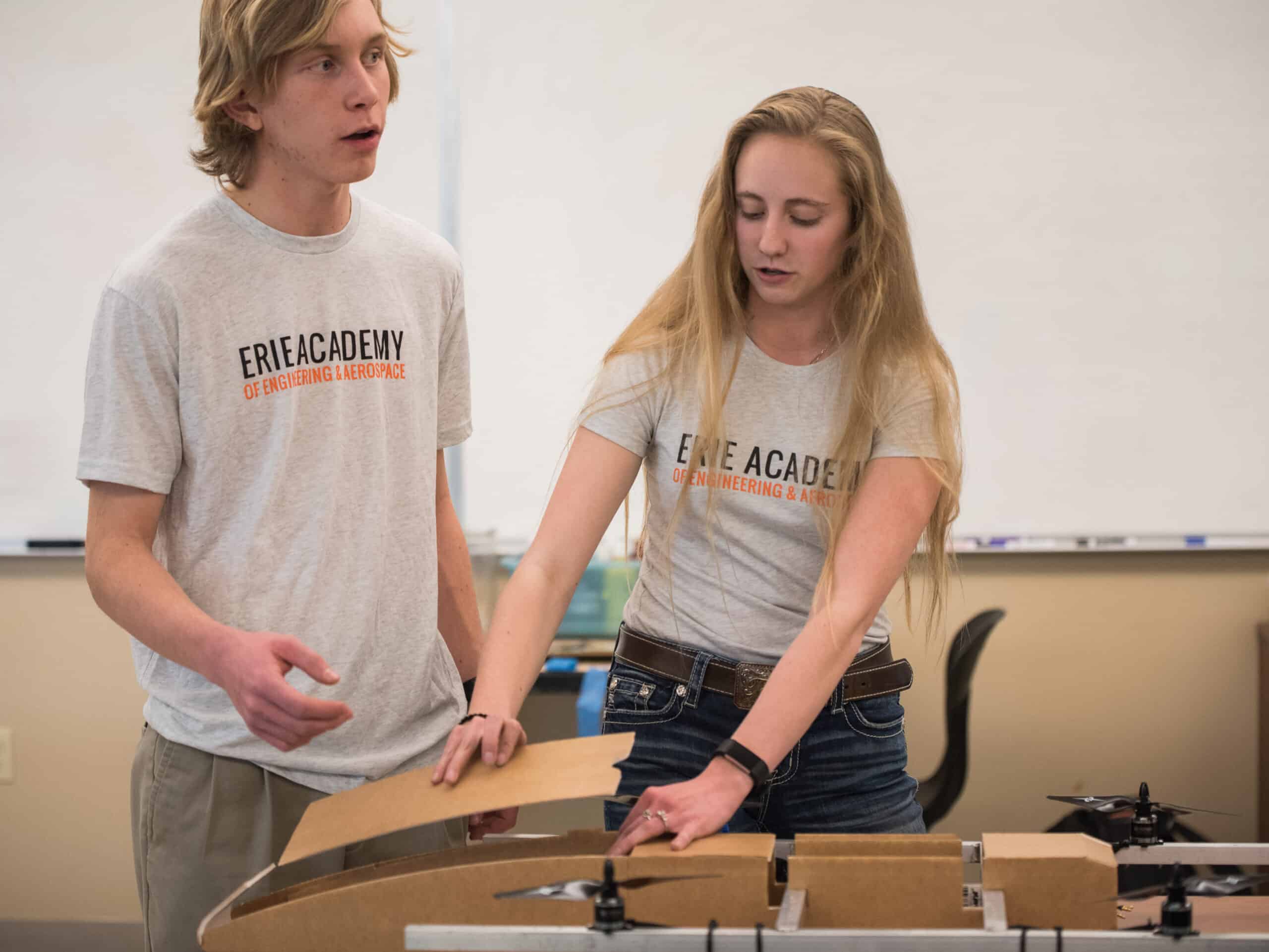
Erie High School’s Academy of Engineering and Aerospace students are once again winning awards for their capstone work. This year’s group of seven students has won the Governor’s Cup, the state level of the Real World Design Challenge, and have been invited to Washington, DC to compete in the national finals. The Real World Design Challenge is a non profit organization overseen by Embry-Riddle Aeronautical University. Each student on the winning national team will receive a $50,000 scholarship from Embry-Riddle Aeronautical University.

The students were tasked to design an Unmanned Aerial System (UAS) that is able to measure plant health in an urban environment. Erie High’s design team, the Skygers, were given a hypothetical city’s map layout and were presented with five different types of vegetation they had to monitor including rooftop gardens and plants on median barriers. The Skygers merged engineering concepts with practical business strategies. Not only did they develop their own theory of operation and design for their unique drone using computer-aided design software (CAD), but they had to create a business plan utilizing a $200,000 budget as well as map out a sustainable path to creating profit.

Kelsey Rasmussen of EHS and Jake Marshall of the Innovation Center have been coaching the Skygers. Rasmussen teaches the Computer Science pathway in the Academy of Engineering and Aerospace, and her colleague Lindsay Fox teaches the Aerospace pathway. Students of computer science and aerospace join together in the capstone engineering class and use skills from both pathways.  

Rasmussen shares a capstone highlight has been to “see the students thrive in a realistic work environment that has many right answers.” She continues, “The students had to analyze the tradeoff for making one decision over another and justify why they proceeded with a certain pathway. The project required students to master self management and project management in order to divide and complete the various tasks of the project.” 

Sophomore student, Andrew Jordan, was invited to join the Skygers because of his strong interest in the project. Jordan shares, “It is awesome to be able to meet with students with similar interests who are willing to work hard on projects that are fun and engaging. The engineering program has prepared me for a future job in engineering by giving me so much experience of a real engineering design job.”  

The Skygers plan to compete in the national competition on April 13 and have fundraised nearly $1,000 to attend. They are still in the fundraising phase and have connected with the CEO of UAS Colorado, Constantin Diehl, to gain support from the local aerospace community for additional funds. UAS Colorado is a non-profit business league with the mission to promote and improve the aerospace industry in Colorado. The Skygers will attend the Rocky Mountain UAS Professionals Meetup Group on March 20 to present their project to the group. Good luck, Skygers!

Rocky Mountain Elementary Hosts First Unified Sports Game

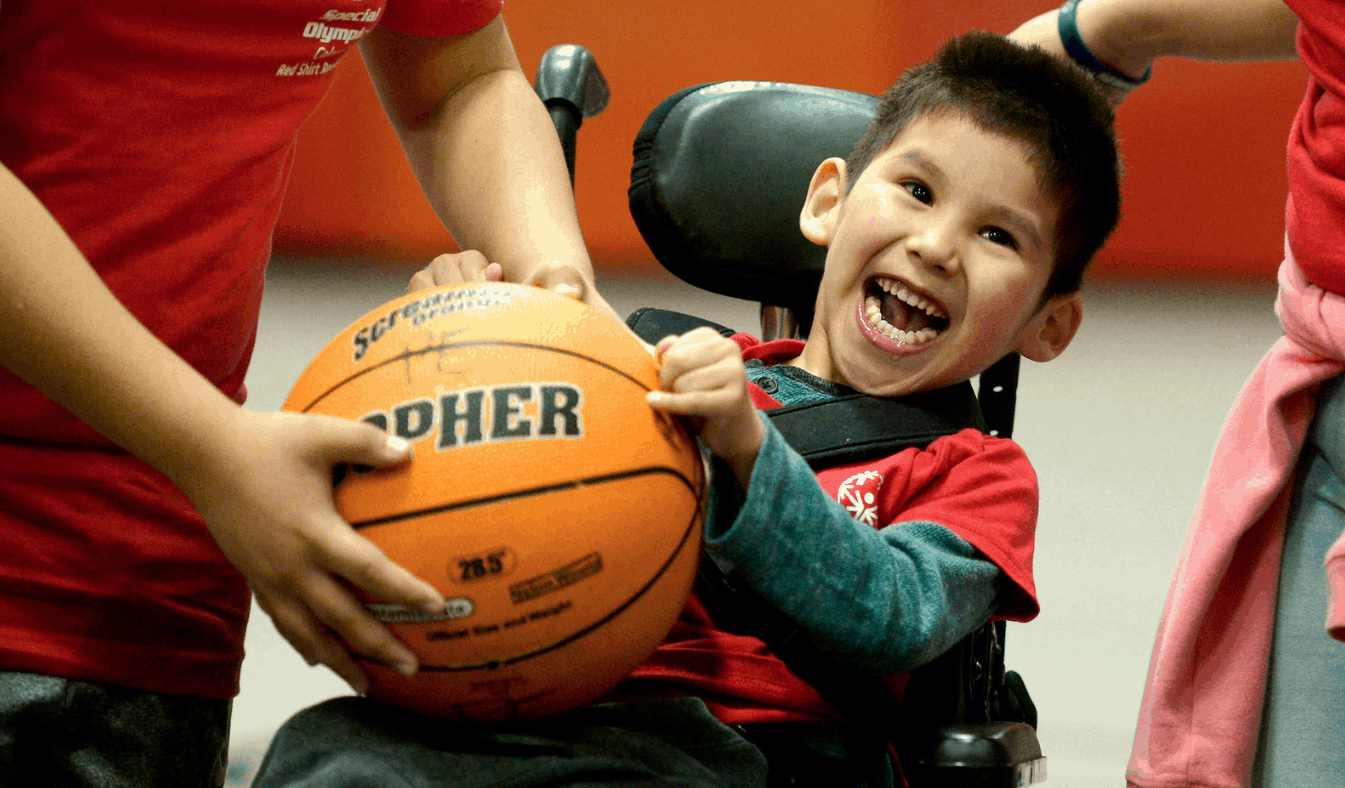
The success of Unified Sports is expanding to the elementary school level with Rocky Mountain Elementary hosting their first Unified Sports Basketball game as part of a weeklong campaign in March to promote social inclusion across the school. The Unified Sports program partners students enrolled in traditional education classes with those in special education classes to compete together in various sports games. Rocky Mountain celebrated the week with different themed dress days, a school wide pep rally, and a culminating staff vs. students Unified basketball game. The students played for the Red Shirt Rookies and beat the staff 44-11, but the celebratory week was a win for all in the Rocky Mountain community. 

 Rocky Mountain Elementary Special Education Para, Jill Vickland, was inspired by her friend, Mead High Special Education Teacher, Amber Vanzant, to bring an elementary level version of the Unified Sports program to Rocky Mountain. Vickland shares, “The week was about spreading awareness of inclusion and bringing joy to all Rocky Mountain Elementary students.”  One of the week’s highlights was the school wide pep rally where the school was colored in red and students wore their Red Shirt Rookies gear in honor of their team’s Unified Sports name. The entire school gathered for an assembly where the athletes were introduced to the crowd and students on the Unified Team shared what their participation in the program meant to them. Fourth grade student, Julian Garcia, has learned a lot serving as a partner in Unified. Julian says the athletes have taught him, “Don’t give up!” and “Just keep trying!”

There was plenty of pep with selected fifth grade students playing original songs for their peers. Music teacher, Jen Goerlitz, assembled a band to include a drummer, singers, guitarists, and keyboard players. The band played their own version of “We Will Rock You,” changing the lyrics to “We Are, We Are Rocky Mountain.” The school even received a visit from the Longmont High cheerleaders who also performed at the assembly.
The main event was the basketball game where Vickland says she was able to see the hard work of the athletes, partners, and staff “become a reality.” The gym had been transformed with the crowd presence, an ESPN booth with students serving as broadcasters, and a volunteer referee. 

Vickland’s hope is that more elementary schools adopt Unified programming so the students can compete with each other. According to Vickland, “Sports is about inclusion and games bring everyone together in a fun and relaxing way. Unified is a great way for kids to mix, learn about each other, and work together.”

St. Vrain Valley Schools