Strong Bonds between Staff and Students Promotes Family Environment at Rocky Mountain Elementary

RMES Staff

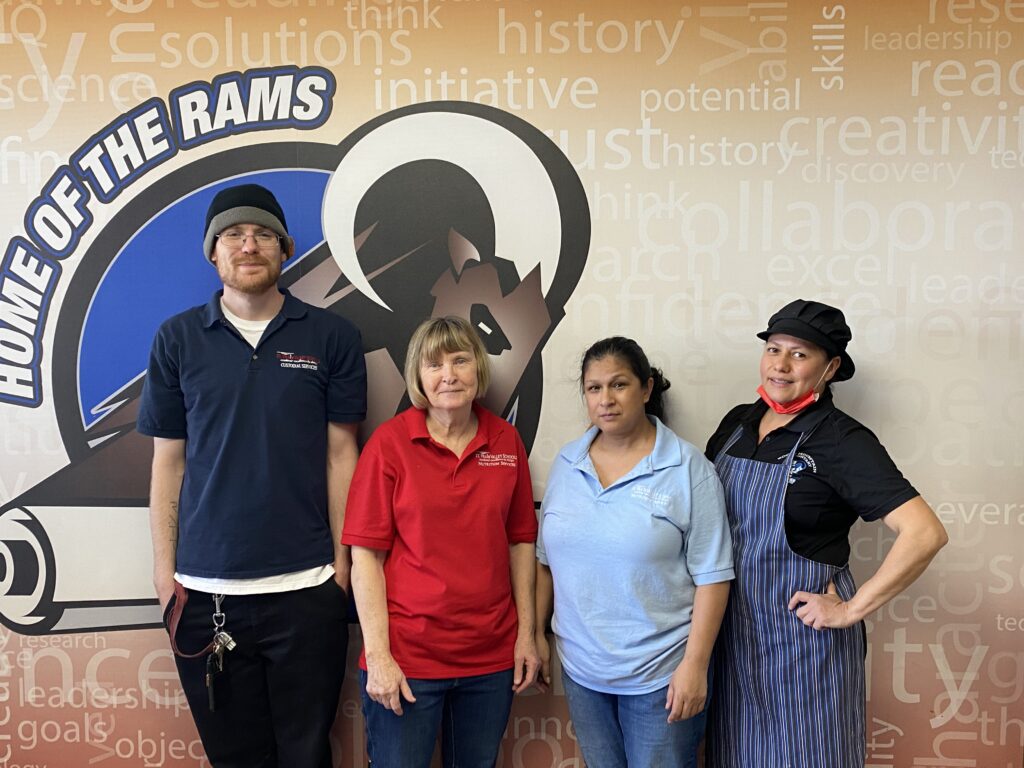
Oftentimes we only focus on the impact that teachers and principals have on learning and education, but the impact that other staff like our custodians and nutrition services team members make behind the scenes can not be overstated. 

When you ask Paxton Heifner, Lead Custodian at Rocky Mountain Elementary School, what his favorite part of his job is, without hesitation he says, “The kids are the best, when they see me and say ‘hi Paxton’ that’s really cute, that makes me smile.” Heifner has been Rocky Mountain’s lead custodian for the last three and a half years. “When I started at Rocky Mountain, the first class to greet me were the second graders, and now they’re fifth graders,” shares Heifner. “Just being able to watch them grow up is something special.” 

For Heifner, the combination of staff and students, “is what makes Rocky Mountain a great school to work at.” Building relationships not only with students but also with staff, makes a big difference for Heifner. “It’s important to like the people you work with, you have to be able to find those joyous moments, even when times are hard,” says Heifner. 

As the fifth graders prepare to move onto middle school, Heifner has a few words of advice. “Middle school might be hard, but if you work hard you’ll make it. Try to find your real friends, those that will go to high school with you, because they will become your true friends, and good luck!”

When you sit down with Cynthia Adler, Kitchen Manager at Rocky Mountain Elementary School, and her team, you immediately feel the love they each have for the students. Cynthia has spent the last 23 years serving and building relationships with students. “Being able to interact with the students, whether it’s taking breakfast to their classroom in the mornings or watching them come into the lunchroom, those are my favorite day-to-day moments,” says Adler. 

“Watching kids grow is one of my favorite moments,” says Paz Rios, Rocky Mountain Elementary School Kitchen Staff, who has been there for 10 years. “When they see you with a smile, that makes their day better – I try my best to make it a place where they feel comfortable.” Working as a team is something that they each strive for. “We spend a lot of time together, not only us, but the kids spend most of their day at school, we have become one family,” says Rios. “I may not know each of the student’s individual circumstances, but my job here is to treat them well, and treat them as if they were my own family.”

Adler believes that one main reason they work so well together is that “we listen to each other’s ideas. One thing might work better for them in a certain way than it does for me, and that’s okay.” Miriam Kramer, Rocky Mountain Elementary School Kitchen Staff, who has been there just a short time, sees the great impact working as a team has on all of the students. “I can truly say that my favorite part of my job is when I get to prepare the food for the kids, but I would not be able to do my job without everyone else,” shared Kramer. 

Adler has seen her share of students come and go from Rocky Mountain in her 23 years of service, and still today Rocky Mountain Elementary School has a special place in her heart. “I have never thought about going to work at a different school, Rocky Mountain is my home, it’s my family!”

Hygiene Elementary Hosting Hawk Air Italy May 5

Hygiene Elementary is hosting an open house as part of its annual Hawk Air project on May 5 from 5:30-7:00 pm. This year, Hygiene Elementary students and staff will be traveling to Italy. 

Hawk Air Italy is a student-driven, teacher-facilitated, and parent-propelled annual capstone project. This year, students and staff will journey to Italy to experience the cities of Rome and Venice and the Tuscany region.

“Throughout the school year, every grade level engages in a fully integrated STEAM learning and design challenges to explore our destination’s culture,” explains Hygiene Elementary Principal, Renee Collier. “At our culminating Hawk Air event, our building is transformed with rich, interactive experiences where students can immerse themselves in architecture, language, art, food, music, and more!”  

Each year, students work to solve a design challenge. This year, students have been challenged to come up with solutions to prevent Venice from flooding. 3D modeling and prototyping utilizing various materials within the school were used to create designs that will be on display at the Open House. 

“With brainstorming, feedback, and iteration, students have improved upon their innovative, creative solutions,” says Collier. “Throughout the process, students learn collaborative strategies to communicate and problem solve, coming to a consensus on ways to improve the world around them.” 

A school-wide vote determines the destination that students and staff travel to every year. Students explore their various options before voting with their peers on a destination for next year.

“At the end of every Hawk Air, students collaboratively preview select countries to gain a general understanding of their options for the next year,” says Collier. “Italy was at the top of the list last year and we can’t wait to see where students determine Hawk Air will go next!” 

Collier is proud of the impact that Hawk Air has on the community. “This is year 12 of Hawk Air and there is nothing like it in the state that brings an entire community together.”

Hygiene Elementary would like to thank our partners, the Hygiene Elementary PTO and Otterbox.

St. Vrain Valley Schools sponsored Up-A-Creek Robotics teams win World Championship in Houston, Texasļæ¼

Up-A-Creek Robotics World Champions

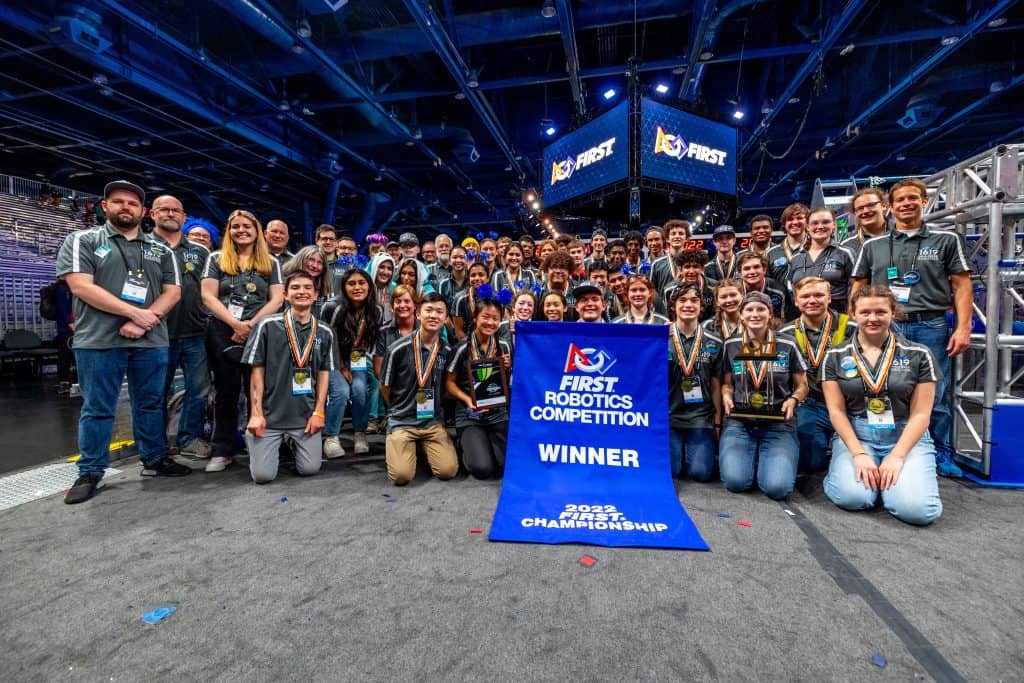
This weekend, two St. Vrain Valley Schools based teams from Up-A-Creek Robotics competed at the World Championship in Houston, Texas, both winning the world championship in their respective competitions in front of an audience of 30,000 attendees at the George R. Brown Convention Center.

Up-A-Creek Robotics participates in three competition types. The FIRST Robotics Challenge (FRC) tasks students with building a 120 lb., 5 ft. tall robot that competes on a basketball court-sized field. The FIRST Tech Challenge (FTC) team tasks students with building an 18 in. robot that competes on a 12 ft. x 12 ft. field. The FIRST LEGO League (FLL), is designed for students in grades 4-8 and they compete with handheld size robots on a tabletop field. 

Both the FRC and FTC teams won the World Championship in Houston, Texas. It was the first win for both teams and the first time a Colorado team has won the FRC competition. Up-A-Creek’s FRC team, #11260, consisted of of 75 high school students across the district. Up-A-Creeks’s FTC team, #11260, consisted of 14 students spanning grades 7-12. The FRC team had an alliance with a team based out of Silicon Valley, CA. The FTC team had an alliance with a team based out of Romania.

Up-A-Creek Robotics started with a dozen students at Silver Creek High School in 2005 and has expanded to 150 students, with eight teams representing seven high schools across St. Vrain Valley Schools, 25 adult mentors, and their own facility and machine shop. “In 2015, we got pretty serious about having a robotics pathway, ” said Teresa Ewing, Computer Science Teacher at Niwot High School. “This is proof that the philosophy of starting students early in STEM bears fruit.” 

Design Thinking Sparks Creativity at Highlands Elementary

Students working on design thinking project

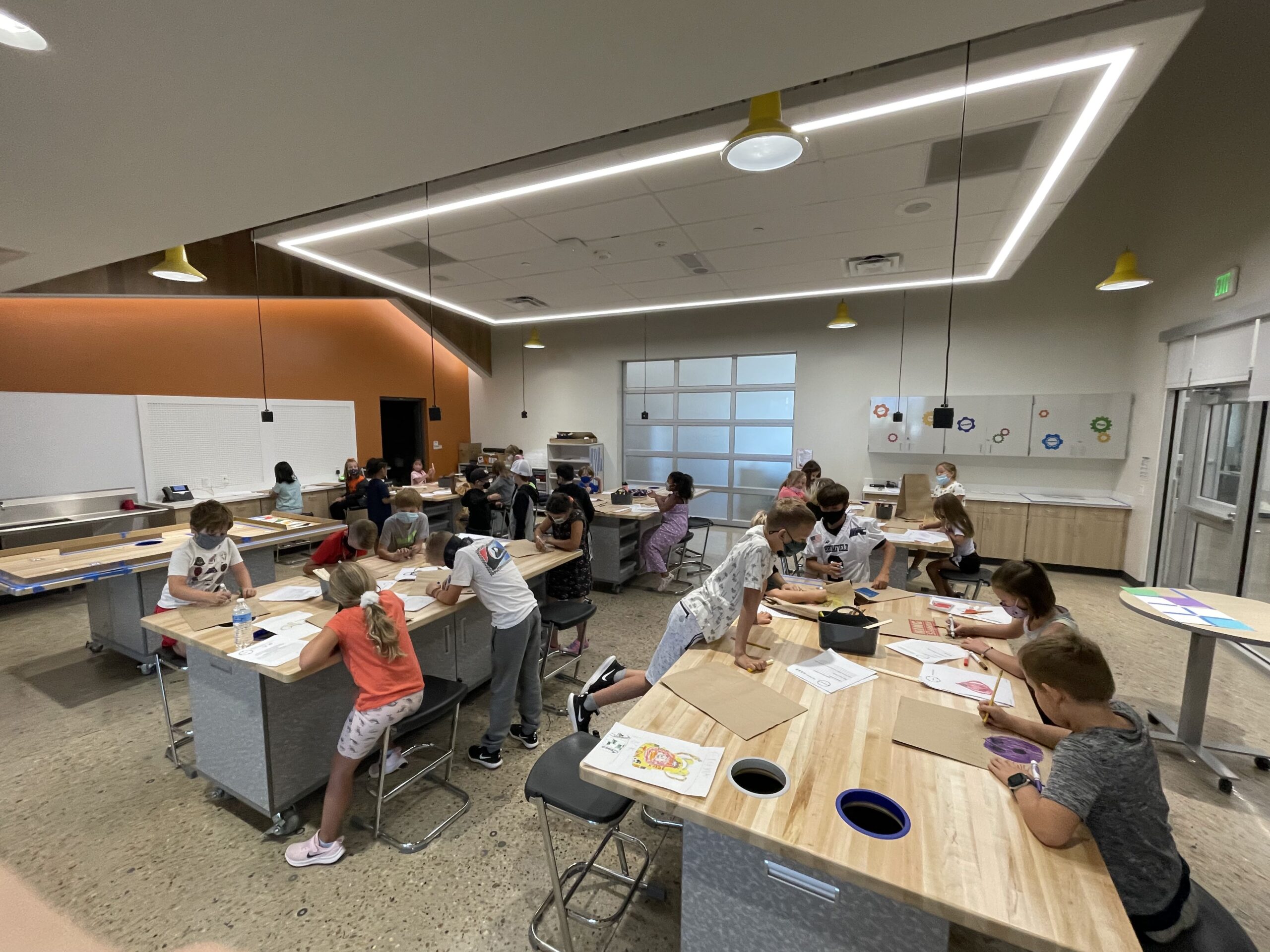
Highlands Elementary, the newest member of St. Vrain Valley Schools, has gotten off to a strong start in its first year. Highlands Elementary’s focus around design thinking promotes a culture of wonder, creativity, and innovation in all students. The implementation of design thinking at Highlands Elementary drives academic excellence and encourages students to reach their full potential. 

According to Highlands Elementary Principal, Ryan Ball, evidence of design thinking is everywhere at the school. “Students and teachers use the language and process everyday. We have succeeded in forming a common language and process. All students participate in school-wide design thinking challenges,” says Ball. 

Students have incorporated design thinking into many projects this year, including designing a community park. Classes worked together with Erie Parks and Recreation and town representatives, receiving feedback on their ideas. “We began by building empathy through interviews of community members and then created user statements that spoke to as many user needs as possible,” says 4th grade teacher, Mandy Warren. “We shared prototypes in an all-school gallery where we invited community leaders in to give us feedback. The city planner was so excited about what we came up with that one of our ideas we had will be incorporated into a local park in the future!” The project has given students a voice in their community, and shown them that their work has a real-world impact. 

More recently, students have been designing games for Highlands Elementary’s inaugural PTO community carnival in May. Once again, students interviewed interested community members of all ages and backgrounds to empathize with potential carnival attendees. Next, students will create user statements, brainstorm design ideas, and eventually build a couple of their designs to be featured during the carnival.   

Highlands Elementary’s students have benefited greatly from the focus on design thinking. “It has given students a structure to be creative, innovative, and wonder. They are asking more questions and are able to research and find creative solutions to problems,” says Ball. Students are encouraged to work together in teams to generate creative solutions to their problems. Fifth graders often support younger grades on projects, empowering the older students and teaching them leadership skills. Students interact with their community and see the impact their work is having on the world. Most importantly, design thinking teachers students to become lifelong learners. “It’s a reminder that the learning cycle is never really finished- there are always more questions to ask, feedback to receive, and ways of thinking about the answers to the problems of the world,” says Warren. 

Students race in AI competition

On Saturday, students from Longmont High School, or LHS, participated in St. Vrain Valley School District’s first DeepRacer Invitational, an Amazon Web Service Hackathon. 

At the event, 16 students worked in teams of two to embed Artificial Intelligence, or AI, and reinforcement learning technologies into 1/18th scale race cars, also called DeepRacer. 

St. Vrain students learn how a team brought a dragon to life

St. Vrain students got to see that dragons can be real with a wish and a push for innovation.

Belle Cress, a 15-year-old from Colorado Springs, stroked her purple-scaled pet dragon as others admired the robotic creature responding to her touch on Wednesday at the Innovation Center. The size of a small dog, the pet dragon was Belle’s wish when she was diagnosed with osteosarcoma, a type of aggressive bone cancer.

A Strong Foundation for Global Acceleration

By Don Haddad, Ed.D., Superintendent

As I reflect on the past three years in St. Vrain Valley Schools, and all that we have achieved during a time of great global disruption, I am reminded of the strong investments we’ve made over a decade ago that have propelled our acceleration and success in a time of great uncertainty.  

More than ever, our world is changing at an exponential rate, and as former Apple CEO, Steve Jobs stated, “Everyone here has the sense that right now is one of those moments when we are influencing the future.” In public education, we also share that sense that we have been given the incredible responsibility and opportunity to shape the future of our communities, state, nation, and world. In the United States, approximately 90% of all people either attend or attended a public school. Accordingly, we believe that second only to parenting, our education system has the greatest impact on our citizens, economy, public safety and national security, our residential and commercial property values, public health, our democracy, and so much more.

In the 21 years that I have been a part of St. Vrain Valley Schools, I have seen the world completely transform at a rapid pace. From my first year as a high school principal, observing September 11, 2001 unfold alongside our students and staff, to assuming the superintendency at the start of the 2008 four-year recession, to managing significant disruption during a 100-year flood in 2013, and now leading a public education system through a global pandemic, our system has been faced with many Rubicon moments, and together, we have bravely crossed over these challenges and emerged stronger.

Education today is incredibly complex for our children and society, and much more significant than anything we have ever experienced. Today’s high school students were coming into the world at the same time Apple introduced the iPhone, Facebook and Twitter launched, Hadoop opened the world’s largest open-source software platforms, Amazon launched the Kindle which could hold a library of books on a single device, and Github opened and gave everyone access to one of the world’s largest repositories of software development. The power and speed of microchips doubled every 18 months, and with IBM’s launch of Watson, artificial intelligence signaled a new era of infinite possibilities.

Given this, it is imperative that we as public education leaders understand the rapid pace of change and prepare students to be successful in our complex, globalized, highly-competitive economy. Over a decade ago, St. Vrain dedicated itself to ensuring that our students were future-ready, and that our teaching practices evolved to ensure that our students would excel in a time of significant acceleration.

To this end, in 2012, through a shared vision and our community’s generous support, we launched our globally recognized Learning Technology Plan in order to equip students with 21st-century technology tools that ensured equitable access to information, and equipped this generation with the resources necessary to expand their capacity to investigate, communicate, collaborate, create, model, lead, and explore solutions within their own schools, communities, and our world. 

In order to ensure that this investment aligned with sound instructional practices, an Instructional Technology Advisory Committee was convened and tasked with developing a set of recommendations for technology access. This is when our incredible partnership with Apple Computers began. Of the numerous devices our committee explored, the iPad provided the greatest level of power, reliability, flexibility, and quality user experience to engage students in creative, complex, and personalized learning opportunities. We started initially with a 1:1 device implementation at our middle schools, and sustainably advanced the program to now include a 1:1 device for all of our 33,000 students in PK-14.

A cornerstone of our Learning Technology Plan is to ensure that we equally prioritize our resource acquisition with the professional development that teachers need to feel and be efficacious, and our ability to sustain the resources as technology continues to evolve and advance. In many districts, technology implementation is focused on obtaining the devices (what can we buy and how many?). Training becomes an afterthought and is driven more by the purchase than by a vision for quality and future-focused learning. Additionally, devices are often purchased with one-time funds without a viable plan to sustain the program with regular device upgrades. In St. Vrain, our strategy placed equal emphasis on obtaining devices that aligned with our forward-thinking vision. We planned for financial sustainability to include regular technology refresh cycles and accommodated student enrollment growth, and delivered ongoing high-quality professional development for teachers and staff so that the tools are best leveraged to advance effective instruction and student outcomes.

We invested heavily in human capital and infrastructure to support a strong implementation. This included a Digital Learning Collaborative in which we convened a committee of teachers, administrators, business leaders, and parents to conduct a needs assessment at all grade levels to study what attributes we valued in our classrooms, such as authentic learning and assessments. We then identified what actions would support these attributes using 21st-century learning tools.

Additionally, we hired a number of instructional technology coaches to work within all schools in our eight feeder systems to support teachers as they infused technology into their instruction at high and engaging levels. They often co-taught with teachers,  problem-solved any issues with technology, and modeled best practices for the creation of new tasks and work products that were previously inconceivable. 

High-quality and timely professional development also played an important role for both teacher buy-in and confidence, as well as consistent implementation. To this end, we hosted an annual summer professional development institute for teachers and staff focused on technology. This experience, which we called Camp iPad, had hundreds of teachers learning from experts in the tech industry, and collaborating with one another on tech-infused lesson plans to be implemented in the next academic year. We also led similar professional development training for parents to become familiar with the new tools and understand best practices in supporting their student’s safety and success at home.

The consistent use of iPad technology across classrooms in St. Vrain, first and foremost, leveled the playing field for all of our students, in terms of ensuring access both at school and at home to digital curriculum materials, current open-sourced information on the web, and the ability to connect and communicate beyond physical boundaries and locations.

In addition to obtaining the powerful iPad devices, we also began to focus heavily on empowering students to think critically through a solutions-driven framework known as design thinking, which was developed at the prestigious Stanford University. The design-thinking process focuses on five key steps where you first empathize and define a problem, ideate a solution, develop a prototype, and finally, test your ideas. 

This is significantly different from the education that many of us experienced from our time in a K-12 school. When I was growing up, we lived six blocks away from our local high school and we would walk back and forth, and this was our neighborhood, this was our world, this was our orbit. For today’s students, their neighborhood is our world. 

In earlier times we would read a chapter and prepare for our unit exam. We’d have eight or nine questions, we’d attempt to memorize what we read, we’d respond, and we’d receive our grade. Now it’s about, can you empathize with a problem? Can you ideate a solution? Can you prototype it and test it? Can you come back and revise it? Can you work together in teams? Can you communicate what you’re thinking? Do you have the perseverance to stick with it until you can find the solution? And, can you predict what might be coming next? And, then when things change, can you change, or are you stuck within that one chapter of that one textbook? These are the durable critical-thinking, advanced skills that we are promoting among our students in St. Vrain.

The design thinking process paired with a powerful device, such as the iPad, are so transformative that we quickly launched into other innovative programs and advanced technological practices. 

Over the past decade, our system has become a nationally recognized model of adaptability, creativity, and innovation. This has resulted in the launch of over 70 diversified and rigorous instructional focus academies and programs across all 60 of our schools, including aerospace, energy, medical and biosciences, leadership, STEM, and visual and performing arts, along with a 55,000 square foot state-of-the-art Innovation Center and 45 foot high-tech Mobile STEM Lab, all supported by our Apple 1:1 technology with robust technology infrastructure, including the second fastest internet service in the United States through our partnership with NextLight. 

This has also provided the opportunity to rapidly elevate our educational programming and student learning opportunities in advanced technologies such as artificial intelligence, cybersecurity, virtual and augmented realities, advanced manufacturing fields such as optics, electronics, machining, and welding, and so much more. We currently have over 160 robotics teams that are competing on the global stage with two dozen teams headed to the world championships next month.

Furthering our mission, we have launched three Pathways through Technology programs, known as P-TECH, in which students earn their two-year associate degree simultaneously with their high school diploma at no cost to the student. Our current programs offer degrees focused on computer information systems, cybersecurity, and biochemistry. We are also continuing to leverage technology to implement new programs and further provide student access to high-quality coursework and instruction through the implementation of a systems-wide Advanced Global Interactive Learning Environment (AGILE) telecommunications program, which will allow students in any of our high schools to receive synchronous, live instruction in courses such as advanced world languages, micro and macroeconomics, computer science, etc., all from their home high school location.

As we have increased rigor, innovation, and technology integration, we have realized significant gains in student achievement. Over the past ten years, St. Vrain’s overall on-time graduation rate has increased 14 percent while our on-time Hispanic graduation rate has increased 31 percent. Additionally, fifth grade reading and math achievement continues to increase, outpacing our state average, with even larger gains in our Hispanic student population. St. Vrain Valley Schools is one of four Colorado school districts, and one of 373 nationwide out of approximately 14,000 school districts, to make the College Board’s Annual Advanced Placement (AP) District Honor Roll for increasing access to AP courses for all students, and in the past five years, our number of AP exams taken has increased 62 percent with scores also increasing greatly. We have also experienced a 201 percent increase in the number of concurrent enrollment college classes taken by our students in the past seven years, and added new opportunities for students to receive college credit through our CU Succeed programs. Accordingly, the Class of 2021 had the opportunity to start their postsecondary education with approximately 32,000 college credits on their transcripts, potentially saving their families over $8.1 million in tuition costs.

Throughout this journey, we have been supported by many leading business and corporate partners, such as Apple, IBM, Boeing, Lockheed Martin, Otterbox, UC Health, Crestone Peak Resources, United Power, Amazon, Google, and Stapp Toyota, who help us understand what the future of workforce readiness will look like, as well as influence and develop the curriculum necessary to provide our children with a world-class education. These partners, and many more, have also provided us with industry experts to mentor our students, and inspire them toward their future endeavors. 

As President John F. Kennedy once said, “Change is the law of life, and those who look only to the past or present are certain to miss the future.” It is critically important that we remember this alongside the common sentiment that tomorrow is a direct result of what we do today – we enjoy the shade of a tree today that was planted 40 years ago. As our schools emerge from the pandemic, I believe that it is imperative that we act with urgency, demonstrating that we understand that the future and success of our civilization is dependent in large part on our willingness to advance our practices. Education is the catalyst for innovation and community advancement. It is the common thread from which our children grow into the leaders who will shape the future.
3.8 Million Meals and Counting

St. Vrain Valley Schools has a strong focus on nutrition and has received many recognitions such as the USDA’s Once in a Melon Award for administering an exemplary farm to school program. Additionally, the 3.8 millions meals that our Nutrition Services team serves each year includes local produce – including organic produce from Colorado’s Western Slope – whenever available. Other program highlights include:

  • Providing over 2,000 snacks daily on Tuesday, Wednesday, and Thursday for extended learning after-school program.
  • Offer special meal modifications daily for 253 students. Currently have over 2,000 special diet needs districtwide including religion preferences, allergies, and special meal modifications.
  • Received an $11,700 grant this year from the Colorado Department of Education and USDA Farm to School Subgrant to support student led and grown agriculture for school cafeterias. Nine schools will participate by growing produce in their established school education gardens, using the yield of produce within their own school cafeteria for recipe development, and taste testing. 
  • Nutrition Services will also utilize two student-run greenhouses at the Career Elevation and Technology Center (CETC) and Burlington Elementary to enable year-round harvesting and purchasing.
  • Partnership with “Cooking Matters” providing online cooking classes for parents and students for 6 weeks. All district students and families K-5 were able to participate.
  • Provided support and funding dollars from School Wellness grant to Niwot High, Main Street, Hygiene Elementary, Sunset and Coal Ridge Middle for outdoor classroom projects.

Step-by-Step guide for Bus Rider Application 2022-2023 School Year

Below is a step-by-step guide on what to expect if you need transportation for your student(s). 

Accessing the transportation application:

  • The transportation application window for the 2022-2023 school year begins March 15, 2022. 
  • The Transportation application is only a request, not a guarantee of service.  Please click the link below to begin the process after you review all directions.
  • All families will be prompted to create an account, providing parent name, home address, and phone number.  You will create a login email and password for a one time account creation.
  • When prompted, log in by entering the email and password previously created.
  • When prompted, enter student information and complete your student’s profile.
  • After completing your first student’s profile, either update (save) or add another student to your account and complete an additional student profile.

Beginning your application: 

  • Click “Begin Application” to apply for transportation for your student.
  • Please note:  If your family has a split custody arrangement, look for the check box to select and indicate you are interested in transportation to both addresses.  You must provide the alternate address, and it MUST show in Infinite Campus as an alternate address. To update your address information in Infinite Campus, please contact the office at your student’s current school.
  • Select the student’s name for the application.  If you entered multiple students you will have the option for each student.
  • Select “Transportation Application.”
  • Applicant student grade levels will appear, click the button marked “Select” and select the school to which you are requesting transportation. 
  • To complete your transportation application, select “Complete New Application.” 
  • When prompted, enter the information requested in the transportation application for St. Vrain Valley Schools. Click to proceed. 
  • You will see a confirmation page showing your confirmation number, you will also receive an email at the email address provided confirming the application submission.

Checking your application status:

  • Applications are processed on a continual basis and you will be notified through the family dashboard and by email when your application is actively in process. 
  • Your application status can be viewed in your family dashboard. You will receive an email when there is a status change. Please be sure your email address is current.

If you have questions about the transportation application process or need assistance with technology or the online application, please contact any school’s main office for support.

CLICK HERE TO BEGIN THE TRANSPORTATION APPLICATION >>

St. Vrain Valley Schools